
12kV and 17kV Campground Power System Retrofit
Turlock Irrigation District | Central Valley, California
Project Overview
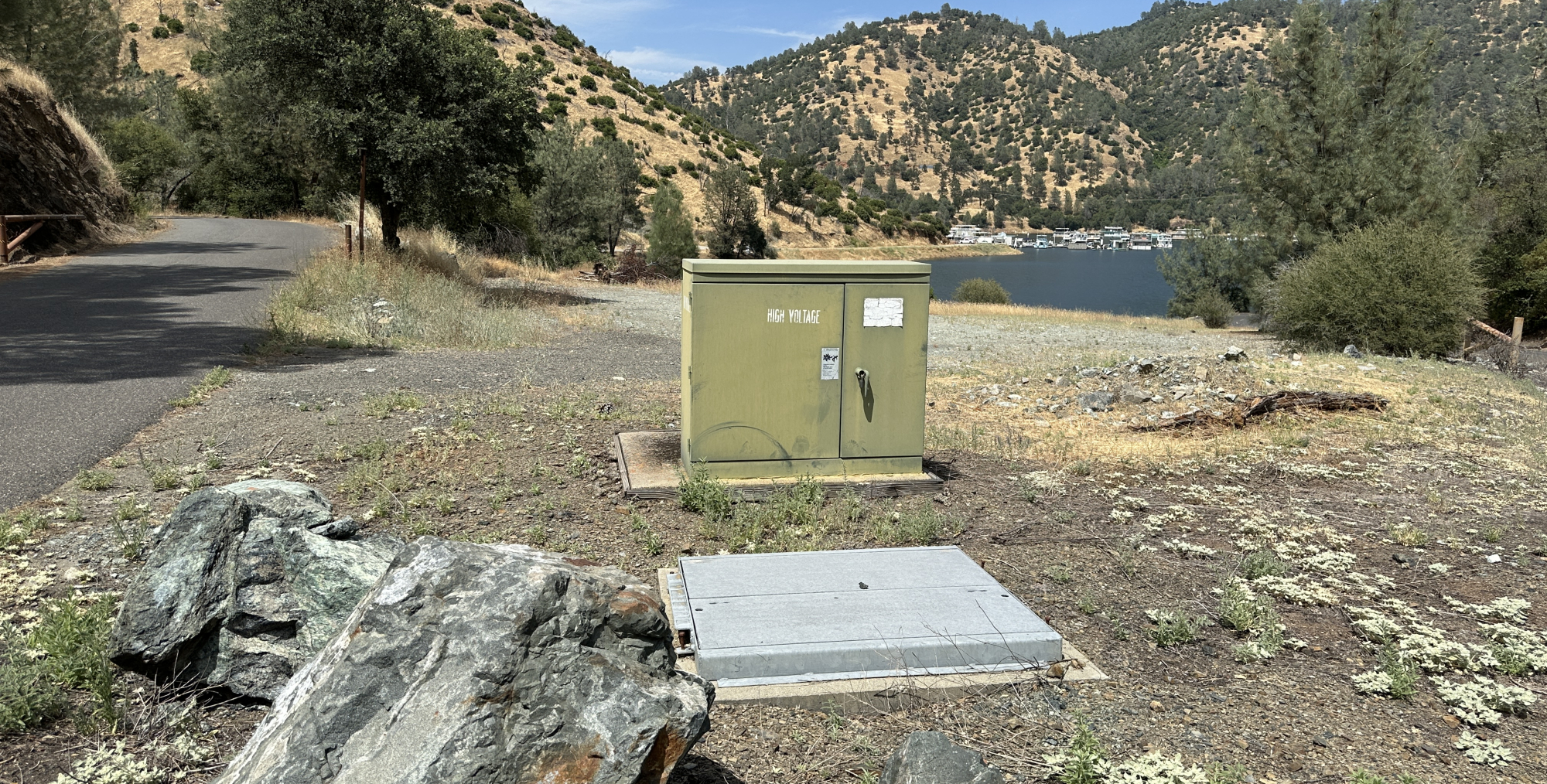
Turlock Irrigation District (TID) retained EETS to fully retrofit the electrical power systems serving three campgrounds originally constructed in the early 1970s. The campgrounds are spread across a large reservoir recreation area in California’s Central Valley, covering many square miles of rugged, hilly terrain with dry, rocky soil that makes underground work particularly demanding.
After more than 50 years of service, the existing infrastructure had reached the end of its useful life. Original contract documents were incomplete, decades of undocumented field modifications had accumulated, and the underground distribution system was a mix of direct buried cable and aging Schedule 20 PVC conduit of unknown condition. The project required EETS to design a modern, reliable power system while navigating all of these unknowns without driving up construction costs or exposing TID to runaway change orders.
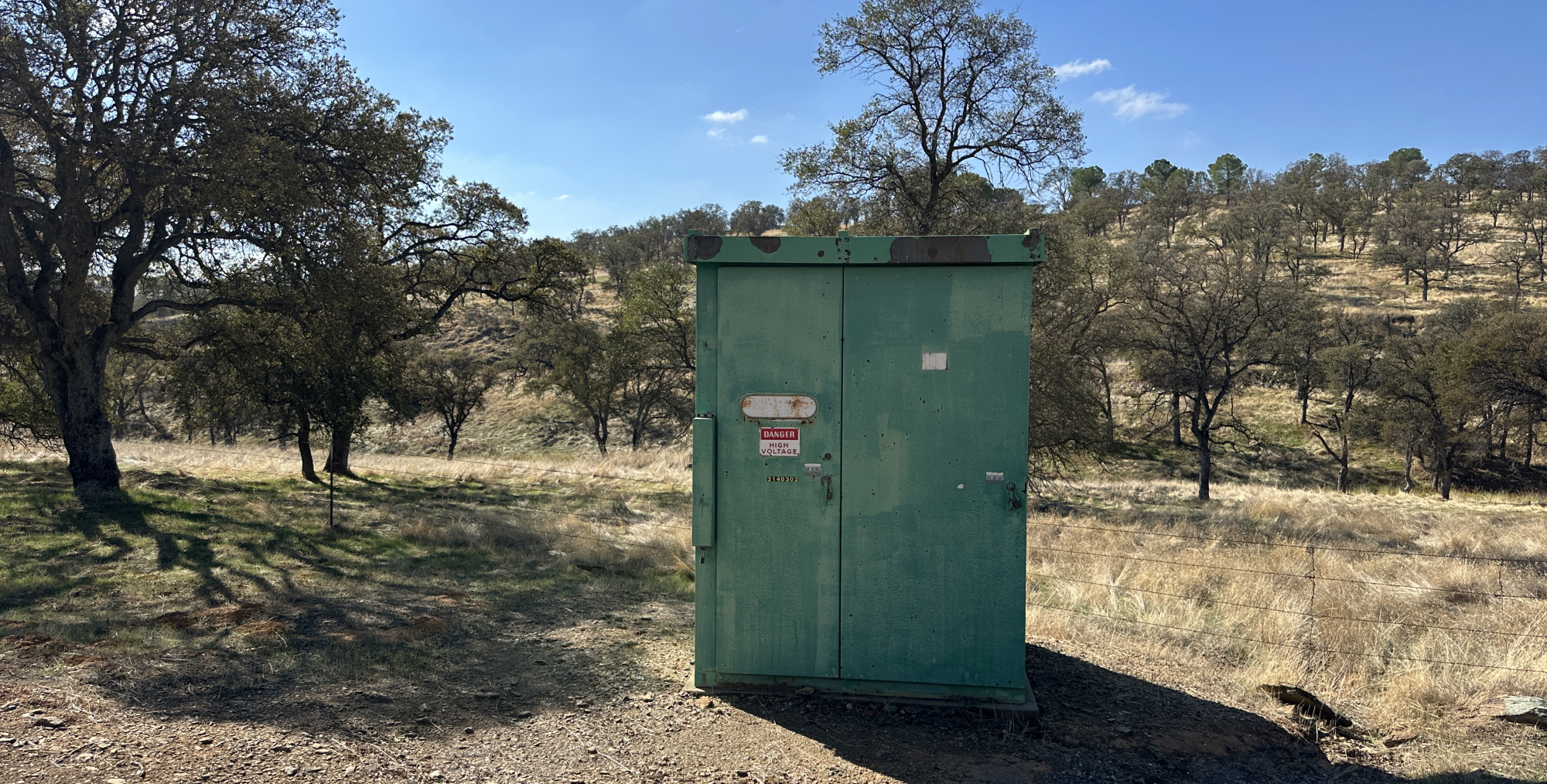
Two of the campgrounds are served by 12,470/7,200V grounded wye, three-phase four-wire systems, each with a dedicated switchgear lineup. The third campground is a single-phase facility served from a 17kV distribution line. Each site presented its own configuration and scope of work.
Project Challenge
Aging Infrastructure with Incomplete Records
Three compounding problems defined this project from the outset.
First, the original 1970s contract documents provided limited design information and did not accurately reflect what was actually installed in the field. Second, retrofits and modifications performed over the intervening decades were not properly documented, leaving no reliable as-built record of the existing systems. Third, the underground 12kV distribution infrastructure consisted of either direct buried cable or Schedule 20 PVC conduit, with no reliable way to determine which was present at any given location, or what condition that conduit was in after 50 years underground.
Layered on top of these documentation gaps was the physical reality of the project site. The campgrounds are separated by many square miles of difficult terrain, with dry, rocky soil and significant grade changes throughout. Trenching costs in this environment are high, and any design approach that pushed investigation or decision-making onto the contractor in the field would have resulted in either an uncompetitive bid loaded with contingency, or a construction phase defined by change orders.
The existing switchgear at the two three-phase campgrounds also lacked any remote monitoring capability. When power was lost, operators had no way of knowing until campers called to complain, sometimes hours after the outage began. Campers could arrive for a weekend stay and spend hours without power before TID was even aware of the problem.
Engineering Solution
A Design Philosophy Built Around Certainty
EETS established a clear principle early in the design process: if something could not be verified with certainty, the design would resolve it rather than defer it to the contractor. This philosophy drove every major decision on the project.
For the underground distribution system, EETS defaulted to specifying new conduit runs for every new circuit, regardless of whether existing conduit might be present. After 50 years underground, Schedule 20 PVC conduit walls are vulnerable to collapse under the lateral pressure of pulling new cable, even if no visible damage exists from the outside. Where cables were direct buried, the problem was even more fundamental. Specifying new conduit from point A to point B gave contractors a clean, unambiguous scope item they could price accurately, with no contingency required for unknown field conditions.
This approach also addressed the site-specific challenge of hard, dry terrain. Rather than asking a contractor to investigate conduit condition across many square miles of difficult ground only to discover mid-construction that a run had to be replaced, EETS built that certainty into the design documents from the start.
Beyond conduit, EETS applied the same logic to any system element that could not be definitively confirmed. Equipment that was verified to be in good working condition was retained. Equipment at the end of its service life was replaced. The design did not over-specify replacements to cover uncertainty, nor did it under-specify and leave the contractor to sort out the difference in the field.
Switchgear Modernization at the Three-Phase Campgrounds
The existing switchgear at the two 12kV campgrounds consisted of an incoming section, a metering section with instrument transformers, and a fused disconnect section as the main protective device. While functional, this configuration offered no trip capability, no relay-based protection, and no remote visibility into system status.
EETS designed replacement switchgear lineups retaining the incoming and metering sections where serviceable, and replacing the fused disconnect section with a modern vacuum circuit breaker as the main disconnect. The new protection scheme includes:
- SEL 501-2 overcurrent relays (redundant X and Y configurations) for primary system protection
- Basler Electric BE1-25 sync check relay to prevent out-of-phase breaker closing against the utility
- 48VDC battery system with charger to provide reliable control power for breaker operation and relay functions
A side cabinet houses the telemetry hardware, including a compact RTU and a 900 MHz unlicensed radio with a Yagi antenna. The 48VDC system steps down to 24VDC to power the telemetry equipment. This configuration transmits the following signals to TID headquarters in near real time:
- SEL 501-2 Relay Trip Status (X and Y)
- Breaker 52a contact status
- Battery high temperature alarm
- Battery charger common alarm
For the first time, TID operators will know immediately when a campground loses power or when the protection system operates, without waiting for a call from a frustrated camper.
Transformer Secondary Protection and Future Flexibility
The campgrounds are served by a mix of padmounted distribution transformers with secondary voltages including 120/240V single-phase, 480V three-phase, and 120/208V three-phase. Where new transformers were added as part of the retrofit, EETS specified a unit breaker on the secondary side of each. This addition costs relatively little at the time of initial installation but significantly improves maintainability and safety for TID crews performing future work on the distribution system.
EETS also oversized new conduit runs beyond the NEC minimum requirements, specifying 4-inch conduit where 2.5-inch would have met code. This provision allows TID to pull additional circuits in the future without excavating new trench across difficult terrain. Pull boxes were added at strategic locations, with conduit stubs routed toward areas where system expansion is most likely, giving future engineers a ready infrastructure to build from rather than starting from scratch.
The 17kV Single-Phase Campground
The third campground, served from a 17kV single-phase distribution line, did not warrant a full switchgear installation. EETS designed an appropriately scaled solution for this site, replacing aging service equipment while maintaining compatibility with the single-phase overhead distribution source. The same design philosophy applied: retain what works, replace what does not, and document everything clearly for future reference.
Client
Turlock Irrigation District
Sector
Public / Municipal Utility
Location
Central Valley, California
Services
Power Engineering Design | Protection and Control | SCADA Telemetry | Distribution System Design

Drink
As part of this expansion, AWA identified an opportunity to recover energy that was previously being wasted.
Client
Turlock Irrigation District
Sector
Public / Municipal Utility
Location
Central Valley, California
Services
Power Engineering Design | Protection and Control | SCADA Telemetry | Distribution System Design
Drink
As part of this expansion, AWA identified an opportunity to recover energy that was previously being wasted.
Project Overview
Turlock Irrigation District (TID) retained EETS to fully retrofit the electrical power systems serving three campgrounds originally constructed in the early 1970s. The campgrounds are spread across a large reservoir recreation area in California’s Central Valley, covering many square miles of rugged, hilly terrain with dry, rocky soil that makes underground work particularly demanding.
After more than 50 years of service, the existing infrastructure had reached the end of its useful life. Original contract documents were incomplete, decades of undocumented field modifications had accumulated, and the underground distribution system was a mix of direct buried cable and aging Schedule 20 PVC conduit of unknown condition. The project required EETS to design a modern, reliable power system while navigating all of these unknowns without driving up construction costs or exposing TID to runaway change orders.
Two of the campgrounds are served by 12,470/7,200V grounded wye, three-phase four-wire systems, each with a dedicated switchgear lineup. The third campground is a single-phase facility served from a 17kV distribution line. Each site presented its own configuration and scope of work.
Project Challenge
Aging Infrastructure with Incomplete Records
Three compounding problems defined this project from the outset.
First, the original 1970s contract documents provided limited design information and did not accurately reflect what was actually installed in the field. Second, retrofits and modifications performed over the intervening decades were not properly documented, leaving no reliable as-built record of the existing systems. Third, the underground 12kV distribution infrastructure consisted of either direct buried cable or Schedule 20 PVC conduit, with no reliable way to determine which was present at any given location, or what condition that conduit was in after 50 years underground.
Layered on top of these documentation gaps was the physical reality of the project site. The campgrounds are separated by many square miles of difficult terrain, with dry, rocky soil and significant grade changes throughout. Trenching costs in this environment are high, and any design approach that pushed investigation or decision-making onto the contractor in the field would have resulted in either an uncompetitive bid loaded with contingency, or a construction phase defined by change orders.
The existing switchgear at the two three-phase campgrounds also lacked any remote monitoring capability. When power was lost, operators had no way of knowing until campers called to complain, sometimes hours after the outage began. Campers could arrive for a weekend stay and spend hours without power before TID was even aware of the problem.
Engineering Solution
A Design Philosophy Built Around Certainty
EETS established a clear principle early in the design process: if something could not be verified with certainty, the design would resolve it rather than defer it to the contractor. This philosophy drove every major decision on the project.
For the underground distribution system, EETS defaulted to specifying new conduit runs for every new circuit, regardless of whether existing conduit might be present. After 50 years underground, Schedule 20 PVC conduit walls are vulnerable to collapse under the lateral pressure of pulling new cable, even if no visible damage exists from the outside. Where cables were direct buried, the problem was even more fundamental. Specifying new conduit from point A to point B gave contractors a clean, unambiguous scope item they could price accurately, with no contingency required for unknown field conditions.
This approach also addressed the site-specific challenge of hard, dry terrain. Rather than asking a contractor to investigate conduit condition across many square miles of difficult ground only to discover mid-construction that a run had to be replaced, EETS built that certainty into the design documents from the start.
Beyond conduit, EETS applied the same logic to any system element that could not be definitively confirmed. Equipment that was verified to be in good working condition was retained. Equipment at the end of its service life was replaced. The design did not over-specify replacements to cover uncertainty, nor did it under-specify and leave the contractor to sort out the difference in the field.
Switchgear Modernization at the Three-Phase Campgrounds
The existing switchgear at the two 12kV campgrounds consisted of an incoming section, a metering section with instrument transformers, and a fused disconnect section as the main protective device. While functional, this configuration offered no trip capability, no relay-based protection, and no remote visibility into system status.
EETS designed replacement switchgear lineups retaining the incoming and metering sections where serviceable, and replacing the fused disconnect section with a modern vacuum circuit breaker as the main disconnect. The new protection scheme includes:
- SEL 501-2 overcurrent relays (redundant X and Y configurations) for primary system protection
- Basler Electric BE1-25 sync check relay to prevent out-of-phase breaker closing against the utility
- 48VDC battery system with charger to provide reliable control power for breaker operation and relay functions
A side cabinet houses the telemetry hardware, including a compact RTU and a 900 MHz unlicensed radio with a Yagi antenna. The 48VDC system steps down to 24VDC to power the telemetry equipment. This configuration transmits the following signals to TID headquarters in near real time:
- SEL 501-2 Relay Trip Status (X and Y)
- Breaker 52a contact status
- Battery high temperature alarm
- Battery charger common alarm
For the first time, TID operators will know immediately when a campground loses power or when the protection system operates, without waiting for a call from a frustrated camper.
Transformer Secondary Protection and Future Flexibility
The campgrounds are served by a mix of padmounted distribution transformers with secondary voltages including 120/240V single-phase, 480V three-phase, and 120/208V three-phase. Where new transformers were added as part of the retrofit, EETS specified a unit breaker on the secondary side of each. This addition costs relatively little at the time of initial installation but significantly improves maintainability and safety for TID crews performing future work on the distribution system.
EETS also oversized new conduit runs beyond the NEC minimum requirements, specifying 4-inch conduit where 2.5-inch would have met code. This provision allows TID to pull additional circuits in the future without excavating new trench across difficult terrain. Pull boxes were added at strategic locations, with conduit stubs routed toward areas where system expansion is most likely, giving future engineers a ready infrastructure to build from rather than starting from scratch.
The 17kV Single-Phase Campground
The third campground, served from a 17kV single-phase distribution line, did not warrant a full switchgear installation. EETS designed an appropriately scaled solution for this site, replacing aging service equipment while maintaining compatibility with the single-phase overhead distribution source. The same design philosophy applied: retain what works, replace what does not, and document everything clearly for future reference.
Key Technical Elements
Parameter | Detail |
Distribution Voltage (3-phase sites) | 12,470/7,200V grounded wye, three-phase four-wire |
Distribution Voltage (single-phase site) | 17kV single-phase |
Main Disconnect (new) | Vacuum circuit breaker, replacing fused disconnect |
Overcurrent Protection | SEL 501-2 relays, redundant X/Y configuration |
Sync Check Protection | Basler Electric BE1-25 |
Control Power | 48VDC battery system with charger |
Telemetry RTU | Compact RTU |
Radio | 900 MHz unlicensed band, Yagi antenna |
Telemetry Power | 24VDC stepped down from 48VDC system |
Secondary Transformer Voltages | 120/240V single-phase, 480V three-phase, 120/208V three-phase |
Conduit Sizing | 4-inch specified where 2.5-inch meets code minimum |
Project Outcome
Design is complete and the project is moving toward construction. When built, TID will have three modernized campground power systems with reliable protection, real-time remote monitoring, and a distribution infrastructure designed to support future expansion without requiring new trenching across miles of difficult terrain. The design documents give contractors a clear, accurate scope with no high-cost field investigation assumptions built in, positioning TID for a competitive bid process and a construction phase with minimal change orders.
Value Delivered by EETS
This project is an example of engineering judgment applied under conditions of genuine uncertainty. The temptation in a retrofit of this complexity is to write ambiguous specifications and let the contractor sort out the unknowns in the field. EETS took the opposite approach: do the work upfront in the design, resolve every uncertainty that can be resolved, and give contractors a set of documents they can price with confidence.
Resolving Uncertainty Before Construction
By defaulting to new conduit installations for every new circuit run, EETS eliminated the single largest source of potential change orders on the project. A contractor discovering mid-pull that a 50-year-old PVC conduit has collapsed under a hillside, miles from the nearest access road, is an expensive problem. Specifying new conduit from the start costs no more and prevents that scenario entirely.
Doing More With the Same Budget
Rather than replacing everything wholesale or deferring improvements that were within reach, EETS carefully evaluated each system component. Equipment in good working condition was retained. Where new equipment was being installed anyway, EETS used that opportunity to add value, including secondary unit breakers on new transformers and oversized conduit for future circuits, at minimal incremental cost.
Building for the Next 50 Years
The conduit oversizing, pull box placements, and conduit stubs toward future expansion areas are investments that cost very little today and save significantly in the future. A future TID engineer pulling a new circuit to an expanded campground section will find infrastructure already in place rather than facing a full trenching project across rocky, hilly terrain.
Giving Operators Visibility They Never Had
The addition of 900 MHz radio telemetry transforms how TID manages these remote facilities. Moving from a system where outages were only discovered through camper complaints to one where operators receive immediate alarms for relay trips, breaker status, and battery system health represents a fundamental improvement in how the district can operate and maintain these assets.
An Engineering Principle Worth Stating
A lesson reinforced by this project: on retrofit work involving old facilities with poor records, the engineer’s job is to resolve as much uncertainty as possible before the contractor ever sets foot on site. Pushing unknowns onto contractors does not make them go away. It simply makes them more expensive, and it makes them someone else’s problem at the worst possible time. EETS designs to eliminate that dynamic, and this project is a clear example of what that approach looks like in practice.
Drink
As part of this expansion, AWA identified an opportunity to recover energy that was previously being wasted.