
69kV SF6 Circuit Breaker Assessment and Substation Retrofit
Contra Costa Water District | Northern California
Project Overview
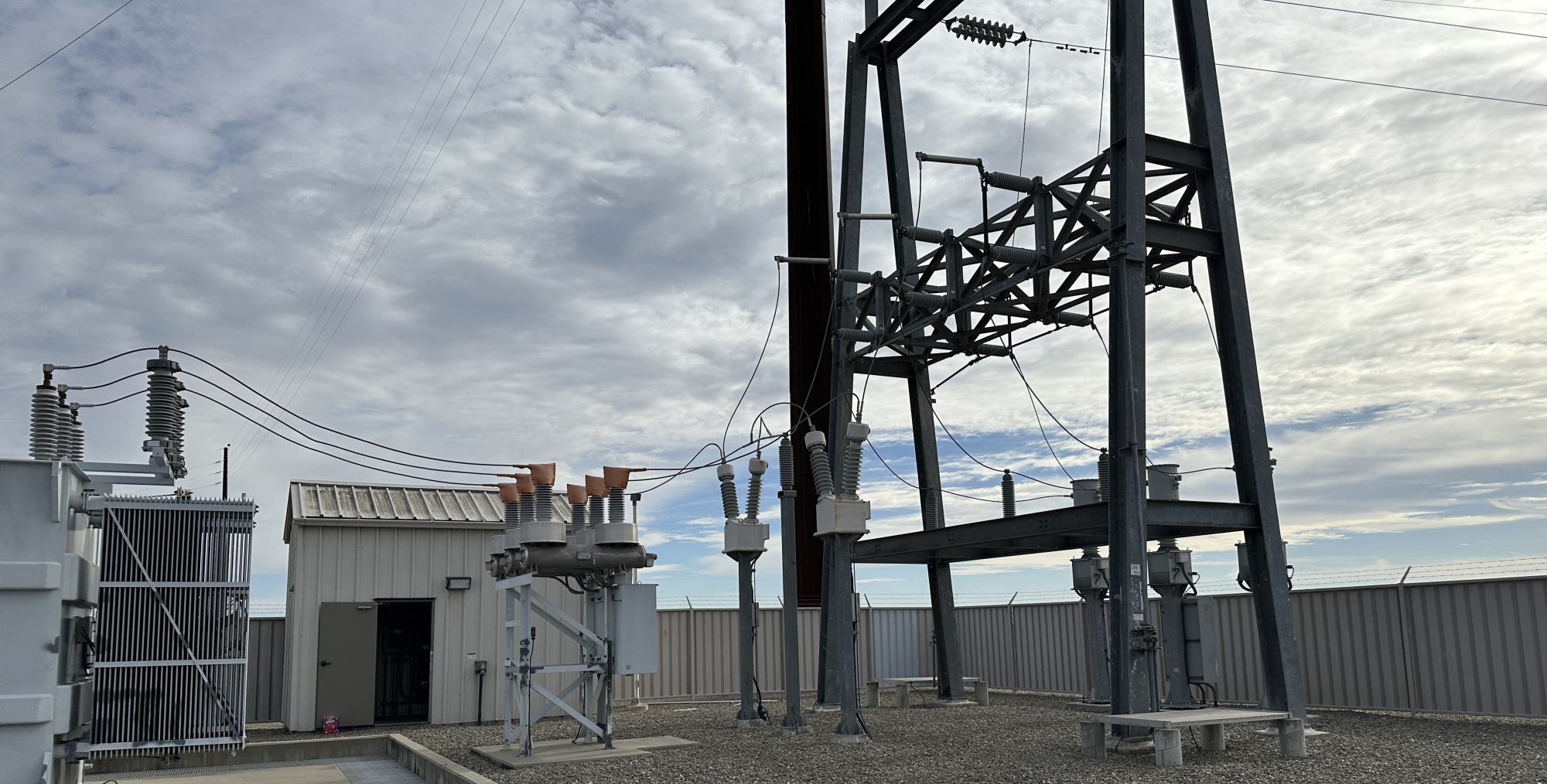
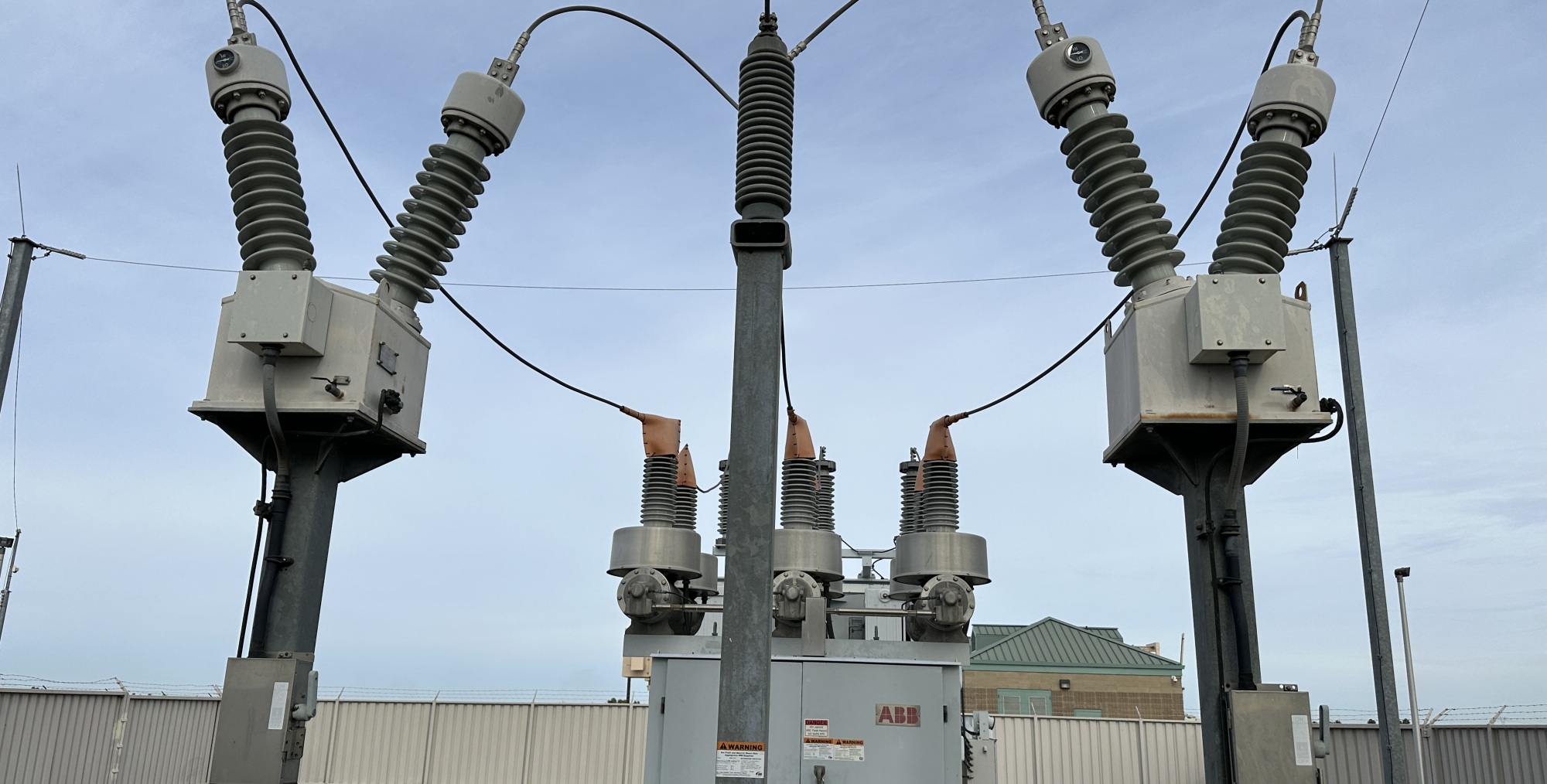
Contra Costa Water District (CCWD) retained EETS to retrofit an existing substation at their Old River Pump Station. The scope included multiple elements of substation work, one of which involved replacing the line and load side bushings on an ABB 72.5kV, 1200A SF6 gas circuit breaker manufactured in 1995. The six porcelain bushings, three on the line side and three on the load side, had sustained damage near the terminals from repeated bird strikes, with high voltage flashover events leaving visible burn marks and structural damage to the insulator surfaces.
The breaker serves as the main 69kV protective device at the substation, with a 20 MVA power transformer connected directly on its load side. Proper operation of this breaker is critical: if the breaker fails to interrupt a fault, the full fault current will travel downstream into the transformer, with potentially catastrophic consequences for both the equipment and the personnel working in the substation.
What began as one element of a broader substation retrofit grew into something far more significant, because EETS looked beyond the defined scope and asked a question that changed the entire direction of the project.
Project Challenge
Scope Guardrails and the Engineer's Obligation to Look Further
On any consulting engagement, respecting the client’s defined scope and budget is a fundamental obligation. A task order exists for a reason, and engineers should not manufacture additional work for themselves. At the same time, the engineer’s role is not simply to execute instructions. It is to serve the client’s best interests, and those two things are not always the same.
When EETS received the task order for bushing replacement, the estimated cost for parts and labor was approximately $120,000. Before proceeding with design, EETS raised a straightforward but critical question: had the breaker itself been evaluated to confirm it was in sound condition? Replacing six bushings on a compromised breaker would not solve the underlying problem. Worse, it would consume $120,000 of the District’s capital budget, require the full procurement and construction cycle that public agencies must follow, and potentially leave a faulty breaker in service. If the breaker failed two years later due to a pre-existing condition, the District would face the entire process again, at far greater cost, and without the benefit of having resolved the real problem the first time.
There was also a regulatory dimension. Beginning in 2025, the California Air Resources Board (CARB) regulations effectively phase out SF6 gas in most electrical equipment, including new circuit breakers. If the existing breaker ultimately needed to be replaced, the District would be required to procure a modern non-SF6 alternative at significantly higher cost and with lead times approaching two years. The timing of that decision mattered enormously.
EETS did not simply raise the concern and move on. We identified a qualified high voltage testing firm, presented the District with a concrete path forward, and continued to advocate for the testing through several rounds of discussion and initial budget resistance. Design work was paused while that third-party field investigation and testing program was conducted.
What the Testing Revealed
The investigation, performed by a qualified high voltage testing firm, uncovered several serious issues that were not visible from the outside.
Most significantly, gas analysis of the SF6 tanks revealed traces of nitrogen contamination inside the breaker’s gas compartments. SF6 gas serves two functions in a circuit breaker: it provides the dielectric insulation that prevents flashover under normal operating voltage, and it quenches the arc that forms when the breaker interrupts a fault current. Nitrogen contamination degrades both of these properties. A breaker with compromised SF6 gas may fail to interrupt a fault, allowing the full fault current to pass through to the downstream transformer rather than being cleared. The likely cause was incorrect topping off of the gas system with nitrogen rather than SF6, a mistake that can occur when the wrong gas cylinder is connected to the breaker’s fill port.
The investigation also found that a local control push button on the breaker’s operating mechanism had seized due to corrosion, rendering it inoperable. The backup trip coil, which provides a redundant tripping path in the event the primary coil fails, was found to be disconnected and not in service. The battery system, which supplies the DC control power required for breaker closing and tripping operations, had insufficient capacity to reliably operate the breaker’s closing mechanism. Field testing confirmed the battery voltage was below the minimum threshold needed to pick up the close relay and release the closing spring.
Taken together, these findings revealed a breaker with compromised gas, an inoperable local control, a non-functional backup trip path, and unreliable control power. A breaker in this condition could fail to close when called upon, or worse, fail to trip and clear a fault.
The Generating Units
The facility uses two induction generators driven by pump-as-turbine units. Pump-as-turbines are standard centrifugal pumps operated in reverse: rather than consuming electricity to move water, they receive pressurized water flow and generate electricity as the water passes through. This approach provides a cost-effective alternative to purpose-built hydraulic turbines while achieving comparable energy recovery performance.
The two generating units are rated as follows:
- Unit 1: 120 kW, 480V three-phase, 0.845 power factor induction generator
- Unit 2: 57 kW, 480V three-phase, 0.83 power factor induction generator
Both units interconnect with PG&E at 480V three-phase under a net energy metering arrangement, with generation metered directly at the facility service voltage.
Client
Contra Costa Water District
Sector
Public / Municipal Water Agency
Location
Northern California
Services
Substation Engineering | Power Equipment Assessment | Specifications and Construction Documents

Drink
As part of this expansion, AWA identified an opportunity to recover energy that was previously being wasted.
Client
Contra Costa Water District
Sector
Public / Municipal Water Agency
Location
Northern California
Services
Substation Engineering | Power Equipment Assessment | Specifications and Construction Documents
Drink
As part of this expansion, AWA identified an opportunity to recover energy that was previously being wasted.
Project Overview
Contra Costa Water District (CCWD) retained EETS to retrofit an existing substation at their Old River Pump Station. The scope included multiple elements of substation work, one of which involved replacing the line and load side bushings on an ABB 72.5kV, 1200A SF6 gas circuit breaker manufactured in 1995. The six porcelain bushings, three on the line side and three on the load side, had sustained damage near the terminals from repeated bird strikes, with high voltage flashover events leaving visible burn marks and structural damage to the insulator surfaces.
The breaker serves as the main 69kV protective device at the substation, with a 20 MVA power transformer connected directly on its load side. Proper operation of this breaker is critical: if the breaker fails to interrupt a fault, the full fault current will travel downstream into the transformer, with potentially catastrophic consequences for both the equipment and the personnel working in the substation.
What began as one element of a broader substation retrofit grew into something far more significant, because EETS looked beyond the defined scope and asked a question that changed the entire direction of the project.
Project Challenge
Scope Guardrails and the Engineer's Obligation to Look Further
On any consulting engagement, respecting the client’s defined scope and budget is a fundamental obligation. A task order exists for a reason, and engineers should not manufacture additional work for themselves. At the same time, the engineer’s role is not simply to execute instructions. It is to serve the client’s best interests, and those two things are not always the same.
When EETS received the task order for bushing replacement, the estimated cost for parts and labor was approximately $120,000. Before proceeding with design, EETS raised a straightforward but critical question: had the breaker itself been evaluated to confirm it was in sound condition? Replacing six bushings on a compromised breaker would not solve the underlying problem. Worse, it would consume $120,000 of the District’s capital budget, require the full procurement and construction cycle that public agencies must follow, and potentially leave a faulty breaker in service. If the breaker failed two years later due to a pre-existing condition, the District would face the entire process again, at far greater cost, and without the benefit of having resolved the real problem the first time.
There was also a regulatory dimension. Beginning in 2025, the California Air Resources Board (CARB) regulations effectively phase out SF6 gas in most electrical equipment, including new circuit breakers. If the existing breaker ultimately needed to be replaced, the District would be required to procure a modern non-SF6 alternative at significantly higher cost and with lead times approaching two years. The timing of that decision mattered enormously.
EETS did not simply raise the concern and move on. We identified a qualified high voltage testing firm, presented the District with a concrete path forward, and continued to advocate for the testing through several rounds of discussion and initial budget resistance. Design work was paused while that third-party field investigation and testing program was conducted.
What the Testing Revealed
The investigation, performed by a qualified high voltage testing firm, uncovered several serious issues that were not visible from the outside.
Most significantly, gas analysis of the SF6 tanks revealed traces of nitrogen contamination inside the breaker’s gas compartments. SF6 gas serves two functions in a circuit breaker: it provides the dielectric insulation that prevents flashover under normal operating voltage, and it quenches the arc that forms when the breaker interrupts a fault current. Nitrogen contamination degrades both of these properties. A breaker with compromised SF6 gas may fail to interrupt a fault, allowing the full fault current to pass through to the downstream transformer rather than being cleared. The likely cause was incorrect topping off of the gas system with nitrogen rather than SF6, a mistake that can occur when the wrong gas cylinder is connected to the breaker’s fill port.
The investigation also found that a local control push button on the breaker’s operating mechanism had seized due to corrosion, rendering it inoperable. The backup trip coil, which provides a redundant tripping path in the event the primary coil fails, was found to be disconnected and not in service. The battery system, which supplies the DC control power required for breaker closing and tripping operations, had insufficient capacity to reliably operate the breaker’s closing mechanism. Field testing confirmed the battery voltage was below the minimum threshold needed to pick up the close relay and release the closing spring.
Taken together, these findings revealed a breaker with compromised gas, an inoperable local control, a non-functional backup trip path, and unreliable control power. A breaker in this condition could fail to close when called upon, or worse, fail to trip and clear a fault.
The Generating Units
The facility uses two induction generators driven by pump-as-turbine units. Pump-as-turbines are standard centrifugal pumps operated in reverse: rather than consuming electricity to move water, they receive pressurized water flow and generate electricity as the water passes through. This approach provides a cost-effective alternative to purpose-built hydraulic turbines while achieving comparable energy recovery performance.
The two generating units are rated as follows:
- Unit 1: 120 kW, 480V three-phase, 0.845 power factor induction generator
- Unit 2: 57 kW, 480V three-phase, 0.83 power factor induction generator
Both units interconnect with PG&E at 480V three-phase under a net energy metering arrangement, with generation metered directly at the facility service voltage.
The Logic Was Written Backwards
Pump-as-turbine units present a control logic challenge that is easy to underestimate. A standard pump is driven by a motor: the motor starts, the pump follows. The control permissives, the logical conditions that must be satisfied before a start command is allowed to proceed, are written around that sequence. A PaT unit operates in the opposite direction. The water drives the turbine, which drives the generator. The permissive logic must reflect that reversed relationship.
The system integrator had written the startup and shutdown permissive blocks as though the units were motor-driven pumps. The logic was effectively inverted: conditions that should have permitted operation were blocking it, and conditions that should have blocked operation were permitting it. The generators were fighting their own control system every time a start was attempted.
Engineering Solution
Rebuilding the Breaker and Expanding the Specifications
With the test results in hand, EETS worked with the District to expand the project scope to address what the investigation had uncovered. The bushing replacement remained in the design, but the specifications were revised substantially to include a comprehensive reconditioning of the breaker.
The SF6 gas was fully evacuated from both tanks and the compartments were refilled with new, uncontaminated SF6 gas to restore proper dielectric and arc interruption capability. The seized push button mechanism was disassembled, cleaned, and restored to full operation. The backup trip coil was reconnected and placed in service, restoring the redundant tripping path. Additional deficiencies identified during the investigation were documented for prioritized future resolution.
The design specifies replacement of all six porcelain bushings, along with polymeric bushing guards to be installed over each new bushing terminal. Unlike the makeshift leather covers fashioned as a temporary protective measure, the specified guards are engineered for high voltage environments and provide durable, long-term protection against bird strikes at the terminal connection points. This directly addresses the root cause of the original bushing damage and reduces the likelihood of a recurrence.
Key Technical Elements
Parameter | Detail |
Breaker | ABB SF6 gas circuit breaker, 72.5kV maximum voltage, 1200A continuous, 31.5kA interrupting rating, manufactured 1995 |
Bushings Replaced | Six porcelain bushings, line and load side, three phases each; damage from repeated high voltage bird strike flashover events |
Bushing Protection | Polymeric bushing guards installed at each terminal to prevent future bird strike damage |
Gas System | Full evacuation and recharge of SF6 gas compartments; nitrogen contamination confirmed and corrected |
Local Control | Corroded push button mechanism cleaned and restored to service |
Backup Trip Coil | Secondary trip coil reconnected and returned to active service |
Control Power | Battery system deficiency identified; properly rated DC battery replacement specified |
Downstream Equipment at Risk | 20 MVA power transformer, connected directly on breaker load side |
Regulatory Context | CARB SF6 phase-out regulations effective 2025; non-SF6 replacement breaker cost and lead time evaluated as part of decision analysis |
Project Outcome
The breaker reconditioning, gas recharge, and bushing replacement were completed successfully. The Old River Pump Station substation was returned to service with its main protective device restored to near-new condition, its redundant protection paths functional, and its bushings protected against the bird activity that had caused repeated damage over the years.
What would have been a $120,000 bushing replacement on a compromised breaker became a comprehensive rehabilitation of a critical piece of infrastructure. The District avoided investing that capital in a half-measure solution, avoided the scenario of a failed breaker interrupt that could have destroyed a 20 MVA transformer, and bought additional years of reliable service life from existing equipment before eventually needing to navigate the cost and lead time of a CARB-compliant replacement breaker.
Value Delivered by EETS
This project is a clear illustration of what proactive engineering consulting looks like in practice. The defined scope was bushing replacement. The real problem was a main protective device that was not in a condition to safely protect the substation it served. EETS identified that gap and advocated for the investigation needed to surface it, even when doing so required persistence through initial budget resistance.
Protecting the Client's Capital Investment
Spending $120,000 on bushings for a breaker with contaminated gas, a failed local control, and a disconnected backup trip coil would have been money spent without solving the underlying risk. By requesting equipment testing before finalizing the design, EETS ensured that the District’s capital went toward a solution that actually addressed the condition of the equipment, not just its most visible symptom.
Connecting the Dots Across the Full System
The bushing damage was the presenting problem. But the nitrogen contamination, the inoperable push button, the disconnected backup trip coil, and the undersized battery were all part of the same picture: a breaker that had not received the full maintenance attention a 30-year-old critical protective device requires. EETS treated the project as a system-level assessment rather than a component-level repair, and the outcome was significantly better for it.
Framing the Regulatory Decision at the Right Time
The CARB SF6 phase-out adds a layer of long-term planning complexity for any agency operating SF6 equipment. By raising this context during the project, EETS gave CCWD the information needed to make an informed decision about whether to recondition the existing breaker or begin planning for a compliant replacement. That is the kind of transparency a client should expect from a consulting engineer, even when the answer complicates the original scope.
An Engineering Principle Worth Stating
Good engineering consulting means looking beyond the edges of the defined task. The scope tells you what the client asked for. Your judgment tells you what they need. When those two things diverge, the engineer’s obligation is to be transparent, lay out the facts, and let the client make an informed decision. EETS advocated for breaker testing when it was not in the budget, because the consequences of not testing were too significant to leave unexamined. That advocacy ultimately protected both the District’s budget and the safety of the substation.
Drink
As part of this expansion, AWA identified an opportunity to recover energy that was previously being wasted.