
4.16 kV Underground Service to the Ice House Dam Valve House
Sacramento Municipal Utility District (SMUD) | Ice House Dam Valve House Power Service from Jones Fork Intake | El Dorado County, California
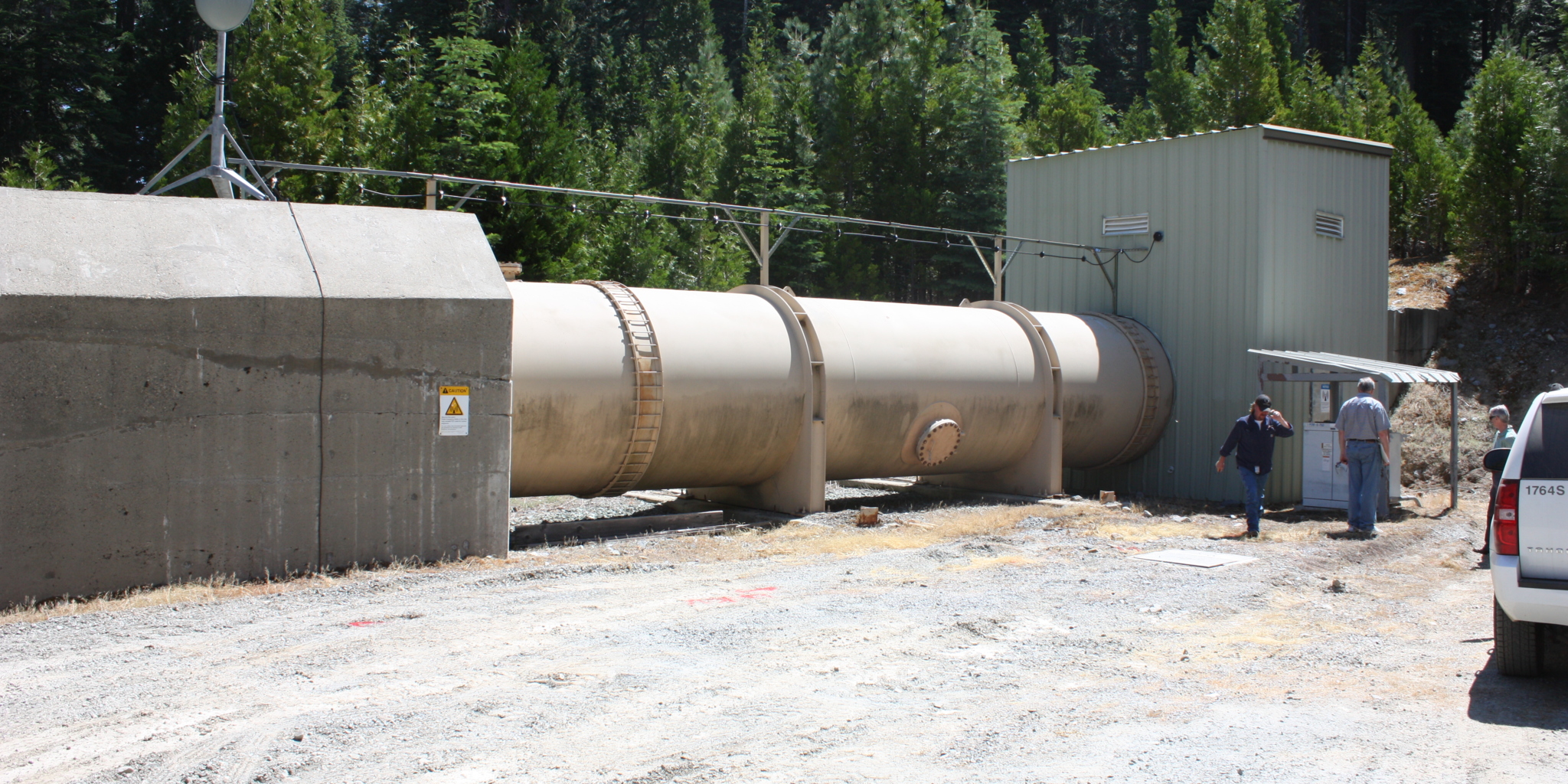
Project Overview
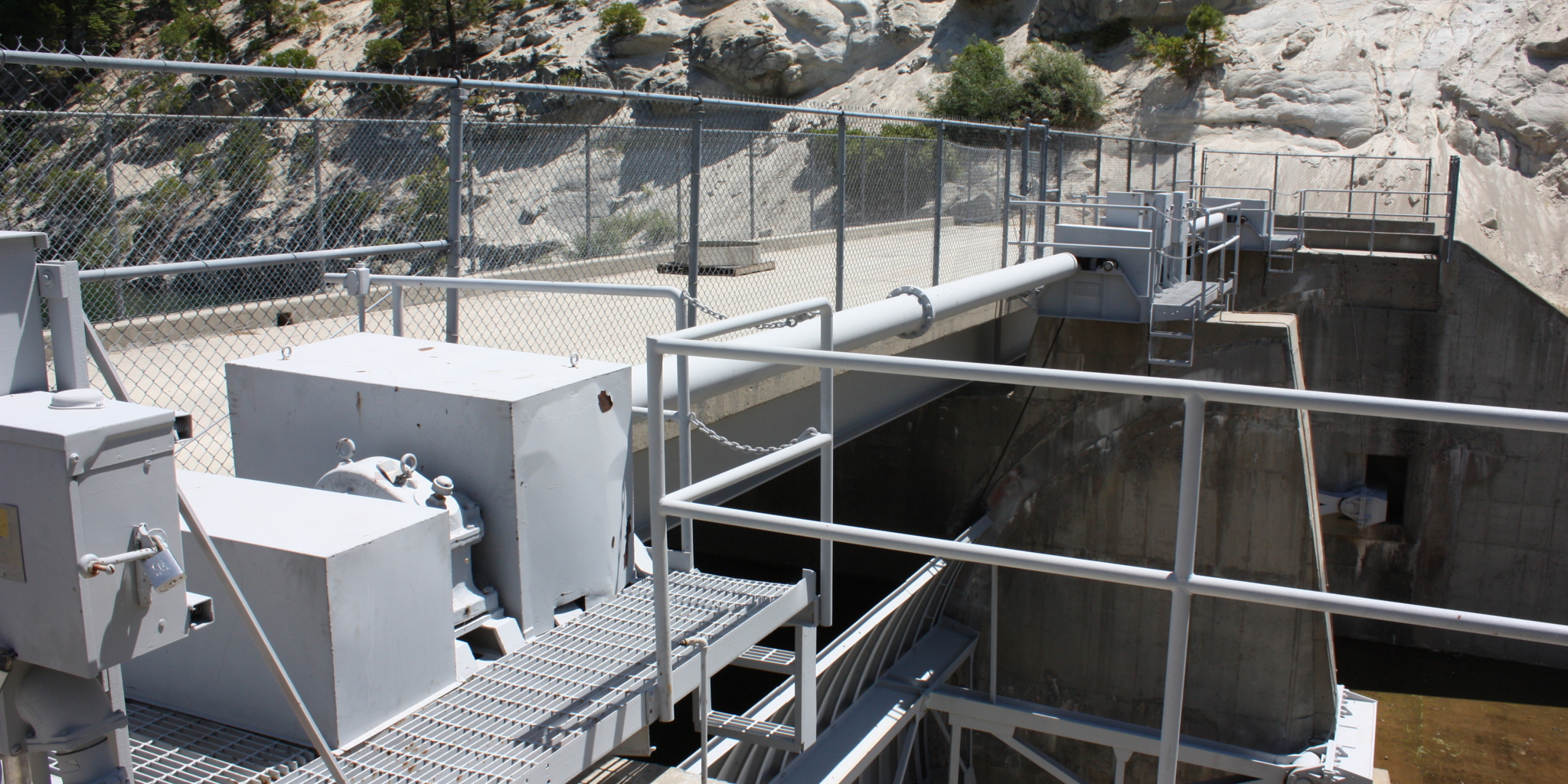
The Ice House Dam Valve House was powered by a lone 10 kW gas engine-generator at 240 V, three-phase. That generator carried the site’s working loads: a 3 HP oil pump motor, the 3 HP motor operator for the Howell-Bunger valve, two 3 HP spillway radial gate operators, and lighting and receptacles served through small transformers at the valve house and the spillway gates. For a dam’s discharge and spillway controls, dependence on a single generator was a reliability risk, and SMUD wanted a full-time utility power source instead.
EETS designed that source. A 4.16 kV service was available roughly a mile away at the Jones Fork Intake structure, so EETS designed a new 4.16 kV, three-phase underground circuit running about 5,800 feet from that structure to a new step-down transformer at the valve house, converting to 240/120 V to feed the existing distribution panel. The existing generator was retained as emergency backup through a new manual transfer switch.
Because the run was long, buried, and feeding motor loads from a medium-voltage source, the design had to do more than route a cable: it had to protect the tap, verify that the motors would start over nearly a mile of cable, confirm the voltage would not float too high under light load, and remain buildable and maintainable in remote mountain terrain.
From a Lone Generator to a Utility Source
The existing service transformer at the Jones Fork Intake structure is a 75 kVA, 4.16 kV (delta) : 480/277 V (wye), loop-fed, deadfront, oil-filled padmount unit, and only one of its two sets of primary bushings was in use. That spare set of bushings was the opportunity: it let EETS extend the 4.16 kV primary to the valve house without adding a new source. From there, a new medium-voltage underground feeder would carry power the length of the run to a new padmount transformer at the valve house, which would step it back down to 240/120 V for the existing panel.
Retaining the generator mattered. Rather than strand the existing engine-generator, EETS tied the new utility service into the valve house through a manual transfer switch, so the site gains a reliable full-time source while keeping the generator available for an extended outage – belt and suspenders for equipment that operates a dam’s valves and spillway gates.
Project Challenge
Starting Motors at the End of a Mile of Cable
Feeding motor loads over roughly 5,800 feet of medium-voltage cable puts the design between two opposing limits. At the heavy end, motors draw a large inrush when they start, and across that much cable the starting current can drag the voltage down far enough to stall a start; the worst case here is the concurrent starting of the three 3 HP motors. At the light end, a long run of shielded cable behaves like a capacitor, and under low load that capacitance can push the voltage up at the far end – the classic long-line voltage-rise problem. A cable sized only for steady running current would satisfy neither limit; the design had to be proven at both extremes of the load envelope.
A Reliable, Protected Buried Feeder in Remote Terrain
The feeder also had to be safe to tap, reliable once buried, and buildable in the mountains. Using loadbreak elbows on the spare bushings as a switching point raises the possibility of ferroresonance under single-pole switching, which had to be engineered out. A direct-buried medium-voltage cable with splices introduces failure points that are expensive to locate and repair in remote ground, so avoiding splices was worth designing for. And the trench itself had to protect a live medium-voltage cable through rock, with an easement to match the chosen route.
Client
Sector
Location
Services

Drink
As part of this expansion, AWA identified an opportunity to recover energy that was previously being wasted.
Client
Sector
Location
Services
Drink
As part of this expansion, AWA identified an opportunity to recover energy that was previously being wasted.
Project Overview
The Ice House Dam Valve House was powered by a lone 10 kW gas engine-generator at 240 V, three-phase. That generator carried the site’s working loads: a 3 HP oil pump motor, the 3 HP motor operator for the Howell-Bunger valve, two 3 HP spillway radial gate operators, and lighting and receptacles served through small transformers at the valve house and the spillway gates. For a dam’s discharge and spillway controls, dependence on a single generator was a reliability risk, and SMUD wanted a full-time utility power source instead.
EETS designed that source. A 4.16 kV service was available roughly a mile away at the Jones Fork Intake structure, so EETS designed a new 4.16 kV, three-phase underground circuit running about 5,800 feet from that structure to a new step-down transformer at the valve house, converting to 240/120 V to feed the existing distribution panel. The existing generator was retained as emergency backup through a new manual transfer switch.
Because the run was long, buried, and feeding motor loads from a medium-voltage source, the design had to do more than route a cable: it had to protect the tap, verify that the motors would start over nearly a mile of cable, confirm the voltage would not float too high under light load, and remain buildable and maintainable in remote mountain terrain.
From a Lone Generator to a Utility Source
The existing service transformer at the Jones Fork Intake structure is a 75 kVA, 4.16 kV (delta) : 480/277 V (wye), loop-fed, deadfront, oil-filled padmount unit, and only one of its two sets of primary bushings was in use. That spare set of bushings was the opportunity: it let EETS extend the 4.16 kV primary to the valve house without adding a new source. From there, a new medium-voltage underground feeder would carry power the length of the run to a new padmount transformer at the valve house, which would step it back down to 240/120 V for the existing panel.
Retaining the generator mattered. Rather than strand the existing engine-generator, EETS tied the new utility service into the valve house through a manual transfer switch, so the site gains a reliable full-time source while keeping the generator available for an extended outage – belt and suspenders for equipment that operates a dam’s valves and spillway gates.
Project Challenge
Starting Motors at the End of a Mile of Cable
Feeding motor loads over roughly 5,800 feet of medium-voltage cable puts the design between two opposing limits. At the heavy end, motors draw a large inrush when they start, and across that much cable the starting current can drag the voltage down far enough to stall a start; the worst case here is the concurrent starting of the three 3 HP motors. At the light end, a long run of shielded cable behaves like a capacitor, and under low load that capacitance can push the voltage up at the far end – the classic long-line voltage-rise problem. A cable sized only for steady running current would satisfy neither limit; the design had to be proven at both extremes of the load envelope.
A Reliable, Protected Buried Feeder in Remote Terrain
The feeder also had to be safe to tap, reliable once buried, and buildable in the mountains. Using loadbreak elbows on the spare bushings as a switching point raises the possibility of ferroresonance under single-pole switching, which had to be engineered out. A direct-buried medium-voltage cable with splices introduces failure points that are expensive to locate and repair in remote ground, so avoiding splices was worth designing for. And the trench itself had to protect a live medium-voltage cable through rock, with an easement to match the chosen route.
Engineering Solution
A Protected Tap onto the Existing Source
EETS connected the new service to the spare primary bushings of the Jones Fork Intake transformer using 5 kV, 200 A loadbreak elbows, landing the new 5 kV, #4 aluminum primary cables on a 5 kV, three-pole, group-operated fusible disconnect switch. The group-operated fusible switch does double duty: it provides overcurrent protection for the cable, and – because all three poles operate together – it avoids the ferroresonant conditions that single-pole switching of loadbreak elbows can create. At the valve house end, a matching 5 kV disconnect switch terminates the run.
A Splice-Free Underground Medium-Voltage Run
The feeder is a 5 kV, three-conductor, shielded, 133% insulated, MV-105, #4 aluminum, EPR direct-buried cable running about 5,800 feet. EETS specified it so the entire length fits on a single standard 84-inch flange cable reel – which means the direct-buried cable can be installed in one continuous pull with no splices, removing the most common buried-cable failure point over the life of the line. The cable sits at the bottom of a 27-inch-deep by 12-inch-wide trench, encased in six inches of red-pigment concrete with 21 inches of backfill above and a high-voltage warning tape with a locator thread over the encasement. EETS worked out the rock-trenching and concrete quantiti es and prepared an easement description for the route.
Step-Down, Backup, and the Studies That Proved It Out
At the valve house, the 5 kV disconnect feeds a new 45 kVA, three-phase, 4.16 kV (delta) : 240/120 V (delta), loop-fed, deadfront padmount transformer set outside the building, with surge arrestors on the second set of primary bushings. Its secondary serves the existing 240 V, three-phase panel through the new manual transfer switch that preserves the generator connection. EETS validated the scheme with analysis: load calculations confirmed the 5 kV cable selection; a motor-starting study showed that even the concurrent start of the three 3 HP, code-J motors held the voltage drop within acceptable limits despite the cable length; and a light-load load-flow study confirmed that cable capacitance would not float the valve house voltage too high. The design met both ends of the envelope it had to satisfy.
Key Technical Elements
Parameter | Detail |
Existing Power | Single 10 kW gas engine-generator, 240 V, three-phase |
Valve House Loads | 3 HP oil pump; 3 HP Howell-Bunger valve operator; two 3 HP spillway radial gate operators; lighting via 0.75 kVA transformers |
Source | Jones Fork Intake 75 kVA, 4.16 kV (delta) : 480/277 V (wye) padmount transformer; new service taps its spare primary bushings |
Primary Connection | 5 kV, 200 A loadbreak elbows to a 5 kV, three-pole group-operated fusible disconnect (overcurrent protection and ferroresonance avoidance) |
Feeder | ≈ 5,800 ft of 5 kV, three-conductor, shielded, 133% insulated, MV-105, #4 aluminum, EPR direct-buried cable |
Constructability | Entire run fits on one 84-inch flange reel – installed splice-free |
Trench | 27″ deep × 12″ wide; 6″ red-pigment concrete encasement, 21″ backfill; high-voltage warning tape with locator thread |
Valve House Transformer | New 45 kVA, 4.16 kV (delta) : 240/120 V (delta) padmount, with surge arrestors, feeding the existing 240 V panel |
Backup | New manual transfer switch retains the existing 240 V engine-generator for extended outages |
Analysis | Load/cable sizing; motor-starting study (concurrent start of three 3 HP code-J motors – acceptable voltage drop); light-load load-flow (acceptable voltage rise) |
Project Outcome
EETS delivered SMUD a complete, buildable design for a full-time 4.16 kV utility service to the Ice House Dam Valve House. The design carries power about 5,800 feet underground from the Jones Fork Intake structure – through a protected, fused tap and a splice-free direct-buried cable – to a new padmount transformer that serves the valve house at 240 V, while a manual transfer switch keeps the existing generator as emergency backup. Motor-starting and load-flow studies confirmed the service would start and run the valve house and spillway motors within acceptable voltage limits at both heavy and light load. The report package gave SMUD everything needed to build it: one-line diagrams, the valve house electrical plan, cable and reel cut sheets and reel calculations, trench details, load and sizing calculations, rock-trenching and concrete quantities, the motor-starting and load-flow outputs, a bill of materials, a cable routing plan, and an easement description.
Value Delivered by EETS
EETS replaced a single-generator dependency with a protected, studied, fully-costed utility service designed to be reliable for the life of the line.
Reliability Engineered In, Not Bolted On
The point of the project was dependable power for a dam’s valves and spillway gates, and reliability shows up in every design choice: a full-time utility source replacing a lone generator, that generator kept as backup through a transfer switch, a fused and group-operated tap that protects the cable and designs out ferroresonance, surge arrestors at the new transformer, and – crucially – a cable specified to install in a single splice-free pull, removing the failure point most likely to strand a buried line years later.
Proven at Both Ends of the Load Envelope
Nearly a mile of medium-voltage cable feeding motor loads creates two opposite risks, and EETS checked both rather than one. The motor-starting study proved that even the worst case – three 3 HP code-J motors starting at once – stays within acceptable voltage drop, and the light-load load-flow study proved that cable capacitance would not push the valve house voltage too high. Sizing the cable against both limits is what makes the service dependable across the full range of how the valve house actually operates.
A Buildable, Fully-Costed Package
EETS handed SMUD not a concept but a construction-ready design: a cost estimate underpinned by real quantities for rock trenching and concrete, an easement description for the route, a single-reel cable specification that shapes how the line is pulled, and a full set of one-lines, plans, cut sheets, and a bill of materials. The engineering and the means to build and pay for it arrived together, ready for SMUD to carry into construction.
Drink
As part of this expansion, AWA identified an opportunity to recover energy that was previously being wasted.