
Independent Review of a Municipal 230 kV Interconnection
City of Lodi Electric Utility (LEU) | 230 kV Interconnection Study and Conceptual Design Review | Lodi, California
Project Overview
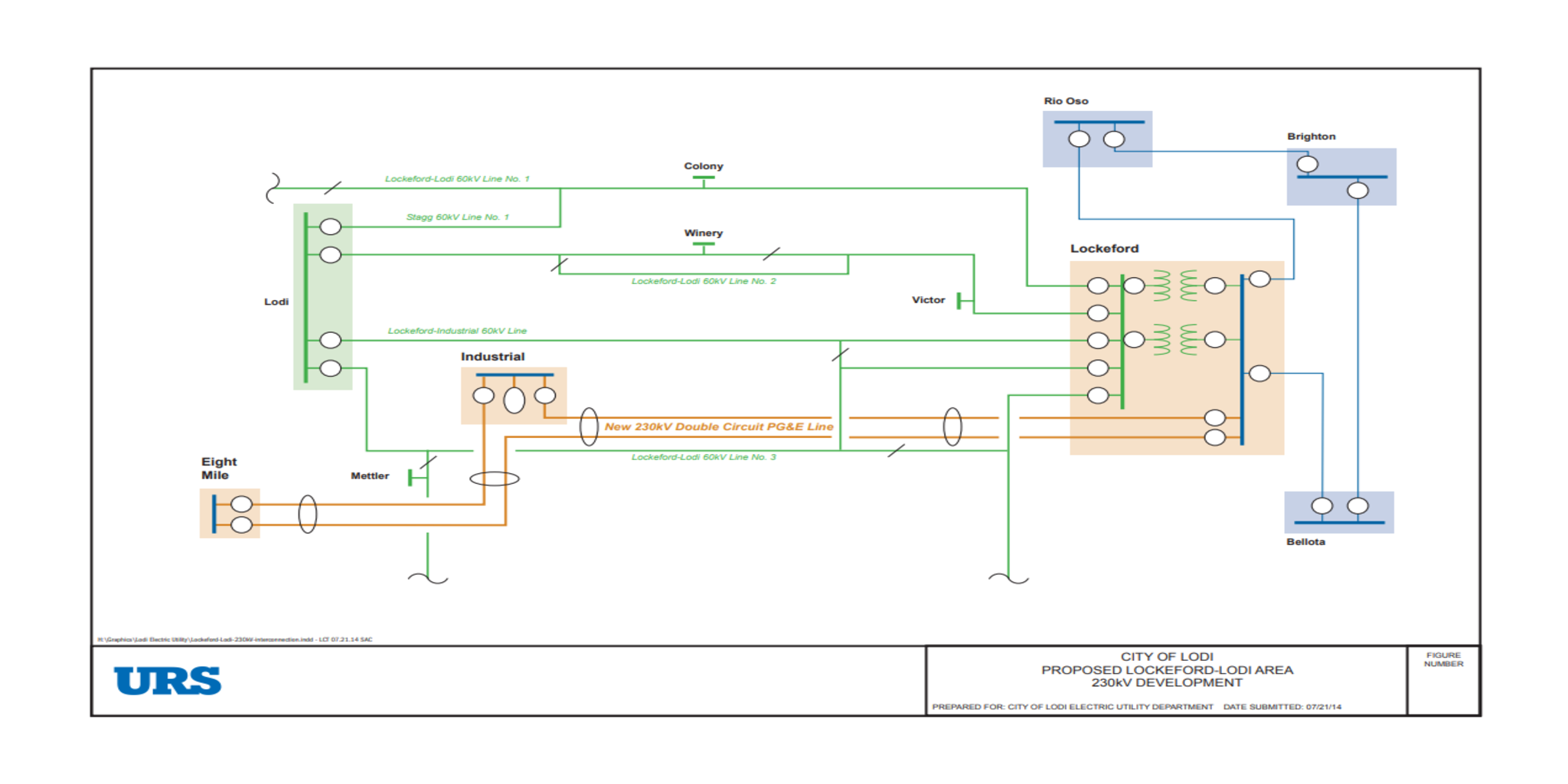
The City of Lodi’s municipal utility (LEU) takes all of its power through 60 kV lines from PG&E’s Lockeford Substation – a single interconnection that leaves the city both capacity-constrained and exposed to system-wide outages. To serve Lodi reliably for the next 20 years, LEU proposed a new project: a new LEU-owned 230 kV substation beside its existing 60 kV Industrial Substation, fed from a new PG&E 230 kV switchyard tied into a looped 230 kV system between PG&E’s Lockeford and Eight Mile Substations.
Before committing to a capital project of that size, LEU wanted independent engineering confirmation that it was sound. LEU contracted with EETS, together with URS, to conduct this Interconnection Study and Conceptual Design Review – an engineering second opinion on the proposed 230 kV interconnection: to analyze it, determine whether it held any fatal flaws, and develop the supporting material LEU needed for its project presentations, cost estimates, and schedule.
EETS’s conclusion was that the project is feasible, rests on standard and proven practice, carries no show-stoppers, and delivers the reliability, capacity, and cost benefits LEU sought – with a set of real but manageable risks that the review mapped to concrete mitigations.
The Proposed Project and Why Lodi Needs It
LEU’s system is constrained by its single 60 kV service from Lockeford, with an existing interconnection capacity of roughly 130 MW (absent generation support from the area combustion turbine). Its 2012 summer peak was 122 MW, earlier peaks had reached 140 MW, and planned residential and commercial growth was pushing load higher; a PG&E area study projected the Lockeford area at 180 MW by 2022 and flagged NERC Category B and C overloads of the 60 kV lines and 230:60 kV transformers, along with low voltages at the Lockeford bus. On reliability, the single interconnection meant that a Lockeford outage took down all of Lodi – the city had experienced four system-wide outages in seven years, the longest about 2.4 hours.
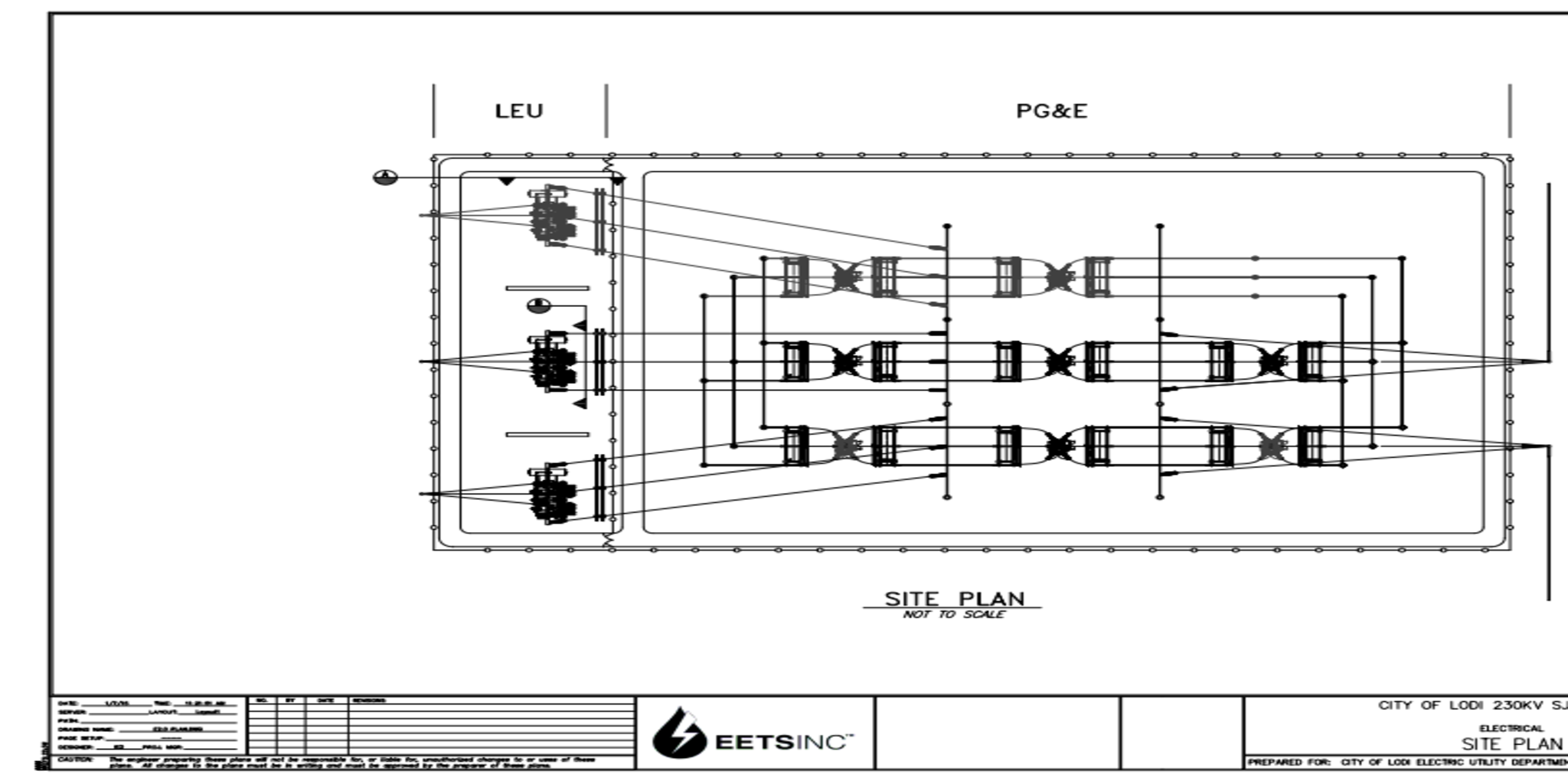
The proposed project answers both problems. A new LEU 230 kV substation steps 230 kV down to 60 kV and connects into the existing Industrial Substation, while an immediately adjacent PG&E 230 kV switchyard – arranged breaker-and-a-half and initially connected as a ring bus, sharing a common fence – receives looped 230 kV service from both the Lockeford and Eight Mile Substations. The existing 60 kV service is disconnected once the new facilities are cut in. Beyond reliability and capacity, taking delivery at 230 kV rather than 60 kV lowers transmission losses and operating costs, eliminating roughly $2.5 million per year in low-voltage transmission access charges. The project’s features had already been approved by the CAISO Board.
Project Challenge
A Single-Source Utility That Has Outrun Its Interconnection
Everything about LEU’s supply hinged on one 60 kV feed. That single point of failure produced repeated city-wide outages, and its roughly 130 MW ceiling was already brushing against 140 MW peaks with growth still coming and PG&E’s own study projecting reliability-standard overloads and low voltages ahead. The proposed remedy was a large, high-voltage, multi-party project, and the central question the review had to answer was whether it was genuinely sound and free of fatal flaws, or whether the city’s own evaluation had missed something.
A Project Split Across Owners, Contractors, and an Energized Substation
The scope did not sit under one roof. It spanned a new PG&E 230 kV switchyard and transmission line, which PG&E would own, and a new LEU 230 kV substation, which LEU would own – built concurrently on a shared site by different contractors under different contracts, then cut over into the existing, energized 60 kV Industrial Substation without interrupting service to the city. A credible review therefore had to weigh not only whether the interconnection works electrically, but whether it can actually be built and coordinated across all of those ownership, contractual, and live-plant interfaces.
Client
City of Lodi Electric Utility (LEU)
Sector
Public / Municipal Electric Utility
Location
Lodi, California
Services
Interconnection Study │ Conceptual Design Review │ Feasibility and Constructability Assessment │ Reliability Analysis │ Risk and Cost Review

Drink
As part of this expansion, AWA identified an opportunity to recover energy that was previously being wasted.
Client
City of Lodi Electric Utility (LEU)
Sector
Public / Municipal Electric Utility
Location
Lodi, California
Services
Interconnection Study │ Conceptual Design Review │ Feasibility and Constructability Assessment │ Reliability Analysis │ Risk and Cost Review
Drink
As part of this expansion, AWA identified an opportunity to recover energy that was previously being wasted.
Project Overview
The City of Lodi’s municipal utility (LEU) takes all of its power through 60 kV lines from PG&E’s Lockeford Substation – a single interconnection that leaves the city both capacity-constrained and exposed to system-wide outages. To serve Lodi reliably for the next 20 years, LEU proposed a new project: a new LEU-owned 230 kV substation beside its existing 60 kV Industrial Substation, fed from a new PG&E 230 kV switchyard tied into a looped 230 kV system between PG&E’s Lockeford and Eight Mile Substations.
Before committing to a capital project of that size, LEU wanted independent engineering confirmation that it was sound. LEU contracted with EETS, together with URS, to conduct this Interconnection Study and Conceptual Design Review – an engineering second opinion on the proposed 230 kV interconnection: to analyze it, determine whether it held any fatal flaws, and develop the supporting material LEU needed for its project presentations, cost estimates, and schedule.
EETS’s conclusion was that the project is feasible, rests on standard and proven practice, carries no show-stoppers, and delivers the reliability, capacity, and cost benefits LEU sought – with a set of real but manageable risks that the review mapped to concrete mitigations.
The Proposed Project and Why Lodi Needs It
LEU’s system is constrained by its single 60 kV service from Lockeford, with an existing interconnection capacity of roughly 130 MW (absent generation support from the area combustion turbine). Its 2012 summer peak was 122 MW, earlier peaks had reached 140 MW, and planned residential and commercial growth was pushing load higher; a PG&E area study projected the Lockeford area at 180 MW by 2022 and flagged NERC Category B and C overloads of the 60 kV lines and 230:60 kV transformers, along with low voltages at the Lockeford bus. On reliability, the single interconnection meant that a Lockeford outage took down all of Lodi – the city had experienced four system-wide outages in seven years, the longest about 2.4 hours.
The proposed project answers both problems. A new LEU 230 kV substation steps 230 kV down to 60 kV and connects into the existing Industrial Substation, while an immediately adjacent PG&E 230 kV switchyard – arranged breaker-and-a-half and initially connected as a ring bus, sharing a common fence – receives looped 230 kV service from both the Lockeford and Eight Mile Substations. The existing 60 kV service is disconnected once the new facilities are cut in. Beyond reliability and capacity, taking delivery at 230 kV rather than 60 kV lowers transmission losses and operating costs, eliminating roughly $2.5 million per year in low-voltage transmission access charges. The project’s features had already been approved by the CAISO Board.
Project Challenge
A Single-Source Utility That Has Outrun Its Interconnection
Everything about LEU’s supply hinged on one 60 kV feed. That single point of failure produced repeated city-wide outages, and its roughly 130 MW ceiling was already brushing against 140 MW peaks with growth still coming and PG&E’s own study projecting reliability-standard overloads and low voltages ahead. The proposed remedy was a large, high-voltage, multi-party project, and the central question the review had to answer was whether it was genuinely sound and free of fatal flaws, or whether the city’s own evaluation had missed something.
A Project Split Across Owners, Contractors, and an Energized Substation
The scope did not sit under one roof. It spanned a new PG&E 230 kV switchyard and transmission line, which PG&E would own, and a new LEU 230 kV substation, which LEU would own – built concurrently on a shared site by different contractors under different contracts, then cut over into the existing, energized 60 kV Industrial Substation without interrupting service to the city. A credible review therefore had to weigh not only whether the interconnection works electrically, but whether it can actually be built and coordinated across all of those ownership, contractual, and live-plant interfaces.
Engineering Solution
Confirming Feasibility, and No Fatal Flaws
EETS reviewed the transmission line, the switchyard, and the substation against established practice and found each on solid ground. Urban 230 kV overhead construction on modern steel poles is common in California; a double-circuit line that loops one circuit through a substation while the other bypasses it is a standard, reliable way to interconnect multiple substations; and the breaker-and-a-half switchyard, initially connected as a ring bus, is a standard PG&E arrangement with good reliability. The City-owned site is flat, more than adequate in area, and well suited to staging. EETS also identified what the next design phase must resolve rather than leaving it implicit: the new Lockeford–Eight Mile tie joins two currently-separate parts of the 230 kV system, so PG&E must run power-flow and stability studies to determine any reinforcements; the site should be geotechnically sampled for soil or groundwater contamination; and moving the 230 kV source closer to Industrial Substation raises its available short-circuit duty, which may require upgrading some 60 kV equipment there.
Validating the Reliability and Cost Case
EETS confirmed the project delivers what LEU needs. Looping 230 kV service through the switchyard gives Lodi two independent source circuits and interconnection to two transmission substations instead of one – an inherent, substantial reliability gain that also removes the looming capacity ceiling and relieves the overloaded-facility stress and low-voltage conditions the area study had projected.
Turning Risk Into a Management Plan
Rather than simply cataloging hazards, EETS separated the risks LEU controls from those it does not, and paired each with a mitigation. The transmission line’s largest wildcards – route selection, regulatory approval, right-of-way, and the possibility of forced undergrounding – sit largely outside LEU’s control and drive schedule and cost; the cost of any PG&E 230 kV system reinforcements is determinable early in design and can be built into the budget; and equipment and construction delays can be absorbed with schedule float and prepurchase of long-lead items such as the main transformers. The risks squarely under LEU’s control – worker safety at the many interfaces with the energized Industrial Substation and the danger of an unplanned outage during cutover – EETS tied to a detailed, step-by-step cutover plan, rigorous pre-service equipment testing, and a full-time qualified construction manager. And it named the one major risk beyond LEU’s control plainly: PG&E’s ability to devote the staff, budget, and attention the project needs, on schedule.
Key Technical Elements
Parameter | Detail |
Existing Service | Single 60 kV interconnection from PG&E Lockeford Substation; ≈ 130 MW capacity (without area combustion-turbine support) |
Reliability History | Four system-wide outages in seven years (longest ≈ 2.4 hours) |
Load | 2012 summer peak 122 MW; prior peaks to 140 MW; PG&E area study projects 180 MW (Lockeford area) by 2022 with NERC Category B/C overloads and low voltages |
Proposed Project | New LEU 230 kV substation (230:60 kV) beside the existing 60 kV Industrial Substation; adjacent PG&E 230 kV switchyard; looped 230 kV from Lockeford and Eight Mile Substations |
Switchyard | Breaker-and-a-half configuration, initially connected as a ring bus (standard PG&E arrangement) |
Ownership | LEU owns/operates the 230 kV substation; PG&E owns/operates the switchyard and 230 kV transmission; CAISO Board approved |
Cutover | New 60 kV tie into Industrial Substation; existing 60 kV service disconnected after construction – staged to maintain service |
Key Risks | Transmission routing / ROW / possible undergrounding; PG&E 230 kV system reinforcements; multi-party and contractor coordination; energized-substation cutover safety; increased short-circuit duty at Industrial Substation |
Reliability Standard | NERC TPL-001-0.1 (Category B and C events) |
Project Outcome
EETS delivered LEU an independent engineering verdict: the proposed 230 kV interconnection is feasible, sound, built on standard and proven transmission and substation practice, and free of fatal flaws. The review confirmed the case for the project – looped 230 kV service through two transmission substations resolves both Lodi’s single-point-of-failure reliability exposure and its 60 kV capacity ceiling. It mapped the project’s real risks, from transmission routing and possible undergrounding to PG&E coordination and the safety and outage risks of cutting over into the energized Industrial Substation, and paired each with a concrete mitigation and the pre-design analyses – geotechnical sampling, short-circuit study – and full-time construction management needed to carry it out. With that second opinion in hand, LEU could advance a major capital project with independent confirmation of its merits and a clear-eyed plan for its risks.
Value Delivered by EETS
EETS gave a municipal utility the independent second opinion it needed to commit capital – confirming the project, validating its economics, and turning its risks into a plan.
An Independent Verdict a Public Utility Could Act On
A capital commitment of this size deserves more than the project’s own advocates. EETS provided the outside engineering judgment that tested the proposal against standard practice, confirmed there were no fatal flaws, and validated both the budget and the roughly annual savings. That is the due diligence that lets a public utility move a major project forward with confidence rather than hope.
Reliability and Capacity, Diagnosed and Confirmed
EETS grounded the project’s justification in the numbers – four city-wide outages, a 130 MW ceiling against 140 MW peaks, and PG&E’s own projection of NERC Category B and C overloads and low voltages – and confirmed that looped 230 kV service to two substations is the arrangement that actually resolves them. The review connected the ‘why’ of the project to the specific reliability and capacity failures it eliminates.
Risk Turned Into a Management Plan
Most valuably, EETS did not stop at listing risks. It distinguished what LEU controls – cutover safety and the danger of an unplanned outage, answered by a detailed cutover plan, pre-service testing, and a full-time construction manager – from what it does not, chiefly PG&E’s delivery of its own scope, and attached a mitigation and a pre-design action to each. That reframing turned an uncertain, multi-party, high-voltage megaproject into something a well-qualified team can manage to a successful outcome.
Drink
As part of this expansion, AWA identified an opportunity to recover energy that was previously being wasted.