
Pole-Top Fire Investigation for a Wind Farm Collector Line
Sacramento Municipal Utility District (SMUD) | Solano Wind Farm 21 kV Overhead Collector Pole-Top Fire Study | Montezuma Hills, California
Project Overview
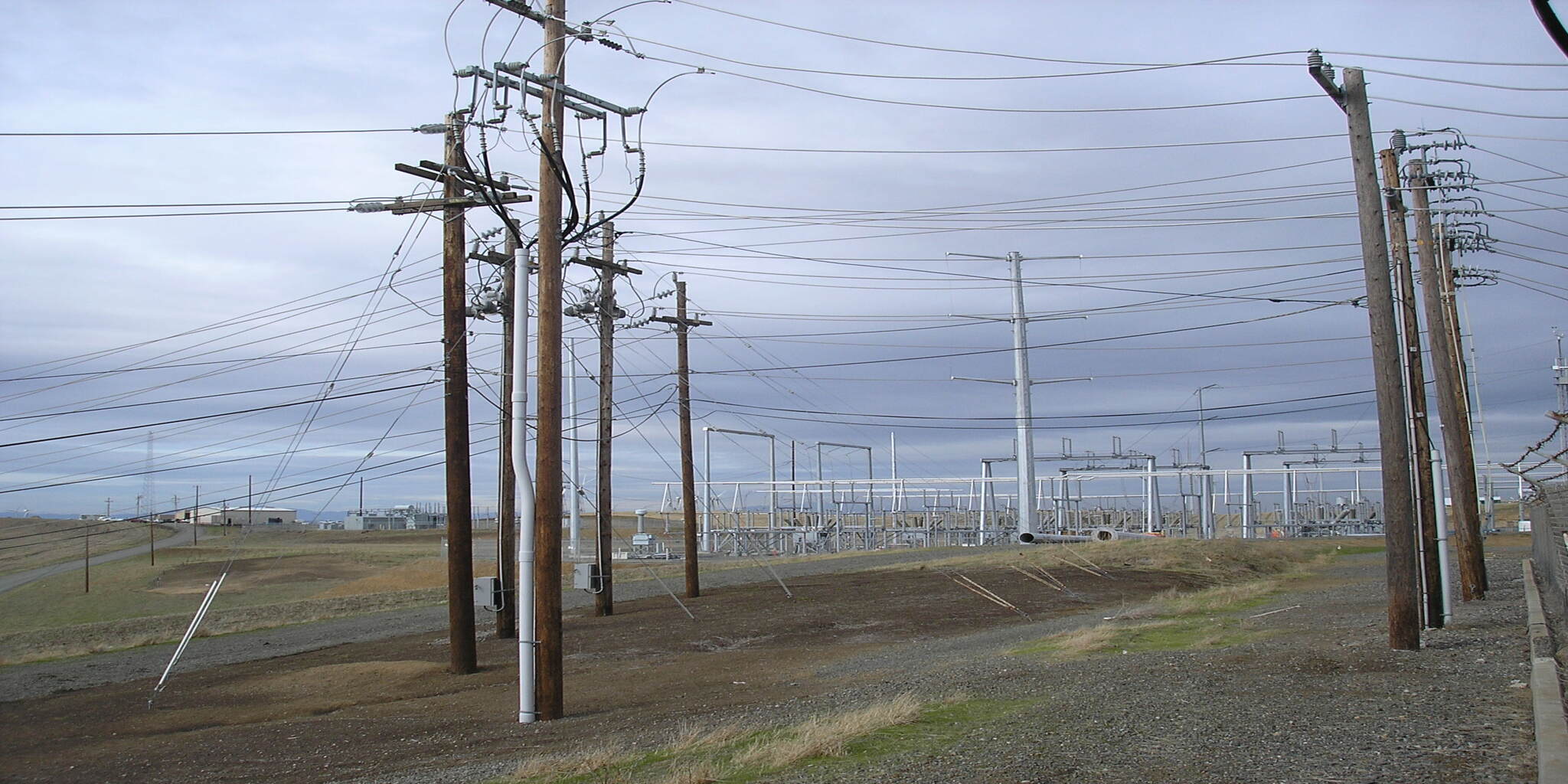
SMUD’s Solano Wind Farm 21 kV overhead collector system had suffered a series of pole-top fires, characteristically occurring after the first rain of the season. Inspection of the fire-damaged poles showed tracking on the insulators, crossarms, and hardware attributable to leakage current, along with fire damage to the wood poles themselves. EETS was engaged to determine why the fires were happening and to recommend how to stop them.
EETS investigated the failure mechanism from the field evidence, reviewed the full range of industry practices, materials, and standards for managing insulator contamination – surveying technical literature back to the 1950s and consulting utilities, line contractors, and insulator manufacturers – and developed a staged, cost-effective mitigation program with per-pole cost estimates.
The recommendation deliberately avoided the expensive answer. Rather than re-insulating the lines, EETS prescribed an annual pre-rain cleaning and standard pole bonding and bridging – sequenced carefully, because done in the wrong order the two measures can work against each other.
Why the Poles Burn After the First Rain
The fires are a seasonal, climate-driven phenomenon. The wind farm sits in open, windy, rural Central Valley terrain with long dry periods – six months or more – between rains, during which windblown dust accumulates undisturbed on the insulator surfaces. When the first rain of the season wets that dust, the conductivity of the contamination jumps and leakage current across the insulator surface rises sharply. Because contamination deposits unevenly, the leakage current dries local bands where more of the voltage then appears, and local arcing begins – a process that escalates toward flashover. That same leakage current also flows across the wood pole to ground, and the heating it produces concentrates at metal-to-pole contact points.
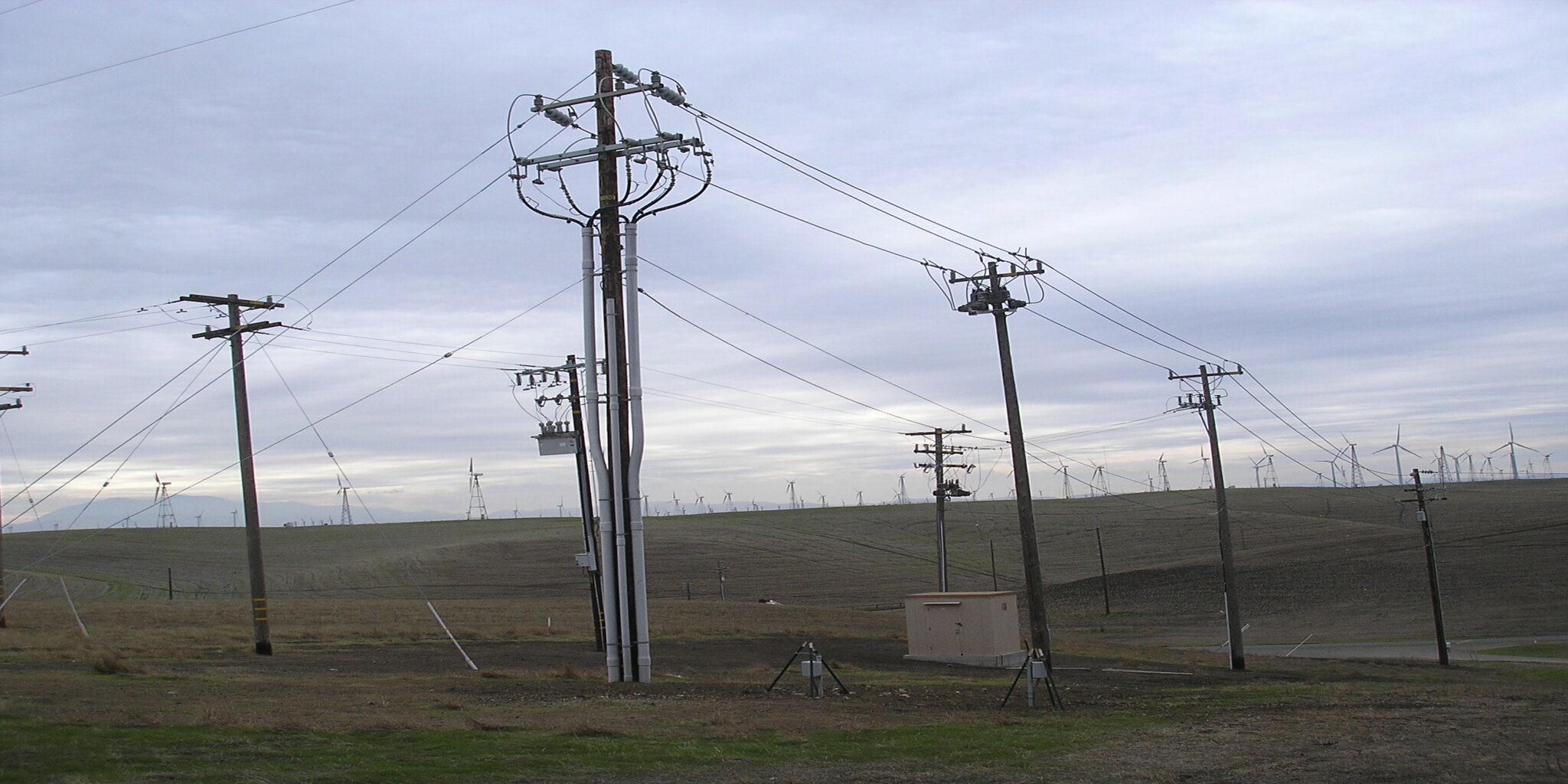
On this line’s construction, that contact point is the weak link. The 21 kV collector uses double-circuit tangent poles with foam-reinforced fiberglass crossarms carrying porcelain post insulators, and per SMUD’s construction standard the crossarm mounting hardware is not bonded. The fire-damaged poles showed tracking running down the fiberglass crossarms from the insulator base to the mounting plate, and burning of the pole exactly where the crossarm mounting plate and through-bolt meet the wood. The evidence pointed directly to the need for a low-resistance path bypassing that connection and carrying the leakage current safely to ground.
Project Challenge
A Seasonal Failure on Code-Compliant Construction
Nothing about the line was wrong by the book: its arrangement, spacing, clearances, grounding, and bonding conform to CPUC General Order 95 and to NESC, and are typical of SMUD’s practice. The failure is driven instead by the site’s climate – a long dry season, abundant windblown dust, and a sudden first rain – combined with an unbonded hardware detail. A fix therefore had to target insulator contamination and the leakage-current path to ground, not correct a code deficiency, and it had to suit a site classified in PG&E’s Insulation District B.
Many Remedies, Real Trade-offs, and One Counterintuitive Risk
The field of possible remedies is wide – several cleaning methods, half a dozen coating chemistries, semi-conducting-glaze and polymer-composite insulators, and hardware bonding and bridging – each with its own cost, service life, and maintenance burden, and wholesale insulator replacement is prohibitively expensive to retrofit. One trade-off is easy to miss and important to get right: bonding and bridging the pole hardware, which is exactly what stops the pole fires, also lowers the resistance that leakage current sees, so on dirty, untreated insulators it can actually increase flashover outages. The measures cannot simply be applied; they have to be sequenced.
Client
Sector
Location
Services
Failure Investigation / Root-Cause Analysis │ Overhead Line Engineering │ Insulator Contamination Assessment │ Standards and Technology Review │ Cost Estimating

Drink
As part of this expansion, AWA identified an opportunity to recover energy that was previously being wasted.
Client
Sector
Location
Services
Failure Investigation / Root-Cause Analysis │ Overhead Line Engineering │ Insulator Contamination Assessment │ Standards and Technology Review │ Cost Estimating
Drink
As part of this expansion, AWA identified an opportunity to recover energy that was previously being wasted.
Project Overview
SMUD’s Solano Wind Farm 21 kV overhead collector system had suffered a series of pole-top fires, characteristically occurring after the first rain of the season. Inspection of the fire-damaged poles showed tracking on the insulators, crossarms, and hardware attributable to leakage current, along with fire damage to the wood poles themselves. EETS was engaged to determine why the fires were happening and to recommend how to stop them.
EETS investigated the failure mechanism from the field evidence, reviewed the full range of industry practices, materials, and standards for managing insulator contamination – surveying technical literature back to the 1950s and consulting utilities, line contractors, and insulator manufacturers – and developed a staged, cost-effective mitigation program with per-pole cost estimates.
The recommendation deliberately avoided the expensive answer. Rather than re-insulating the lines, EETS prescribed an annual pre-rain cleaning and standard pole bonding and bridging – sequenced carefully, because done in the wrong order the two measures can work against each other.
Why the Poles Burn After the First Rain
The fires are a seasonal, climate-driven phenomenon. The wind farm sits in open, windy, rural Central Valley terrain with long dry periods – six months or more – between rains, during which windblown dust accumulates undisturbed on the insulator surfaces. When the first rain of the season wets that dust, the conductivity of the contamination jumps and leakage current across the insulator surface rises sharply. Because contamination deposits unevenly, the leakage current dries local bands where more of the voltage then appears, and local arcing begins – a process that escalates toward flashover. That same leakage current also flows across the wood pole to ground, and the heating it produces concentrates at metal-to-pole contact points.
On this line’s construction, that contact point is the weak link. The 21 kV collector uses double-circuit tangent poles with foam-reinforced fiberglass crossarms carrying porcelain post insulators, and per SMUD’s construction standard the crossarm mounting hardware is not bonded. The fire-damaged poles showed tracking running down the fiberglass crossarms from the insulator base to the mounting plate, and burning of the pole exactly where the crossarm mounting plate and through-bolt meet the wood. The evidence pointed directly to the need for a low-resistance path bypassing that connection and carrying the leakage current safely to ground.
Project Challenge
A Seasonal Failure on Code-Compliant Construction
Nothing about the line was wrong by the book: its arrangement, spacing, clearances, grounding, and bonding conform to CPUC General Order 95 and to NESC, and are typical of SMUD’s practice. The failure is driven instead by the site’s climate – a long dry season, abundant windblown dust, and a sudden first rain – combined with an unbonded hardware detail. A fix therefore had to target insulator contamination and the leakage-current path to ground, not correct a code deficiency, and it had to suit a site classified in PG&E’s Insulation District B.
Many Remedies, Real Trade-offs, and One Counterintuitive Risk
The field of possible remedies is wide – several cleaning methods, half a dozen coating chemistries, semi-conducting-glaze and polymer-composite insulators, and hardware bonding and bridging – each with its own cost, service life, and maintenance burden, and wholesale insulator replacement is prohibitively expensive to retrofit. One trade-off is easy to miss and important to get right: bonding and bridging the pole hardware, which is exactly what stops the pole fires, also lowers the resistance that leakage current sees, so on dirty, untreated insulators it can actually increase flashover outages. The measures cannot simply be applied; they have to be sequenced.
Engineering Solution
Diagnosing the Mechanism from the Evidence
EETS tied the physical evidence to the physics. The tracking on the fiberglass crossarms and the burning at the crossarm-to-pole connection are the signature of surface leakage current on contaminated insulators finding a path through the unbonded mounting hardware to ground, and the timing – the first rain after a long dry season – matches the contamination-and-wetting mechanism precisely. EETS confirmed the construction meets GO 95 and NESC and placed the site in PG&E Insulation District B, framing the problem as one of contamination management and leakage-path control rather than reconstruction.
Reviewing the Full Field of Practice and Technology
EETS surveyed the industry’s accumulated knowledge – literature dating to the 1950s, and the practices of PG&E and WAPA, line contractors, and insulator makers – and evaluated each class of remedy. Cleaning, governed by IEEE Standard 957, covers hand, pelletized-air, and demineralized-water pressure washing, energized or de-energized. Coatings range from temporary silicon grease, to RTV silicone (permanent, but which loses its water-repellency for up to a day after rain – precisely when it is needed), to fluorourethane-silicone, a hard, slippery, rain-stable coating with a service life beyond ten years. Alternative insulators include semi-conducting-glaze porcelain and silicone-rubber polymer composites. And pole bonding and bridging – per PG&E’s standards for wood-pole lines – address the pole-heating path directly. Each was weighed on effectiveness, longevity, maintenance, and cost.
A Staged, Cost-Graduated Program — in the Right Order
EETS recommended a sequence rather than a single product. First, an annual early-fall pressure washing of the insulators with demineralized water per IEEE Standard 957, timed before the first rains – the direct counter to the seasonal mechanism, and performable with the lines energized or de-energized. Second, and only after cleaning, bonding the insulator pins to a pole ground and adding bridging conductors to bypass the crossarm hardware per PG&E standards 06667 and 056845, so the pole-heating path is removed without the lowered leakage-path resistance worsening flashovers on dirty insulators. A fluorourethane-silicone coating was held in reserve, to be applied only if annual washing proved insufficient. And wholesale replacement of the porcelain insulators was explicitly not recommended, given the retrofit cost – though silicone-rubber polymer insulators were recommended for any future collector-line construction at the site. EETS costed each measure per pole across the system’s 189 poles.
Key Technical Elements
Parameter | Detail |
System | 21 kV overhead collector, double-circuit tangent poles; foam-reinforced fiberglass crossarms with porcelain post insulators; 189 poles across four circuits on two double-circuit segments |
Symptom | Recurring pole-top fires after the first rain of the season; tracking and burning at the crossarm-to-pole connection |
Mechanism | Dust accumulation over the long dry season + first-rain wetting → surface leakage current → dry-band arcing / flashover and pole heating at unbonded crossarm hardware |
Site Classification | Complies with CPUC General Order 95 and NESC; PG&E Insulation District B |
Cleaning | Annual early-fall pressure wash with demineralized water (> 1500 Ω-cm) per IEEE Standard 957; energized or de-energized |
Bonding & Bridging | Bond insulator pins to a pole ground and add bridging conductors per PG&E standards #06667 and #056845 – performed after cleaning |
Key Trade-off | Bonding/bridging lowers the leakage-path resistance and can increase flashover outages on dirty insulators – hence sequence after cleaning |
Coatings (fallback) | Fluorourethane-silicone – permanent, rain-stable hydrophobicity, > 10-year life (≈ $500/gal, ≈ 8 poles/gal) |
Not Recommended | Wholesale porcelain-to-polymer insulator replacement (retrofit cost); use silicone-rubber polymer on future construction |
Project Outcome
EETS delivered SMUD a diagnosed cause and a practical, staged remedy. The fires trace to windblown dust accumulating on the collector insulators through the long dry season and igniting leakage-current tracking when the first rain arrives, with the pole burning concentrated at the unbonded fiberglass-crossarm hardware. Rather than an expensive re-insulation, EETS recommended a low-cost, correctly-ordered program: an annual early-fall pressure wash before the rains, followed by pole bonding and bridging per PG&E standards to protect the poles – sequenced so the bonding does not worsen flashovers on dirty insulators – with a fluorourethane-silicone coating held in reserve and silicone-rubber polymer insulators reserved for future construction. Each measure was costed per pole across the 189-pole system, giving SMUD a clear, affordable path to stop the fires and limit damage to poles, crossarms, insulators, and hardware.
Value Delivered by EETS
EETS explained why the poles burned – exactly where, when, and how – and prescribed the cheapest measures that address the actual mechanism, in the order that makes them work together.
Root Cause, Not Just Symptoms
The value began with the diagnosis. EETS connected the specific field evidence — tracking down the fiberglass crossarms and burning at the through-bolt — to the seasonal physics of dry-season dust, first-rain wetting, and an unbonded leakage-current path, explaining not merely that the poles caught fire but precisely where the heat concentrates, when the risk peaks, and why. That understanding is what lets a fix be targeted rather than a guess.
The Right Fix for the Money
Presented with everything from exotic coatings to full polymer-insulator replacement, EETS recommended the least-cost measures that actually address the mechanism – an annual pre-rain wash and standard bonding and bridging – and explicitly declined the costly re-insulation, reserving coatings and polymer insulators for the situations where they earn their cost. The recommendation is anchored by per-pole estimates so SMUD could budget it directly.
Getting the Sequence Right
The subtle, decisive insight is one of order. Bonding and bridging stop the pole fires, but by lowering the resistance that leakage current sees they can increase flashover outages if the insulators are dirty. By prescribing cleaning first and the hardware changes after, EETS turned two measures that could have undermined each other into a coherent program – the difference between fixing one failure mode and trading it for another.
Drink
As part of this expansion, AWA identified an opportunity to recover energy that was previously being wasted.