
Pump-as-Turbine Hydroelectric Facility Design and Commissioning
San Bernardino Valley Municipal Water District | Southern California
Project Overview
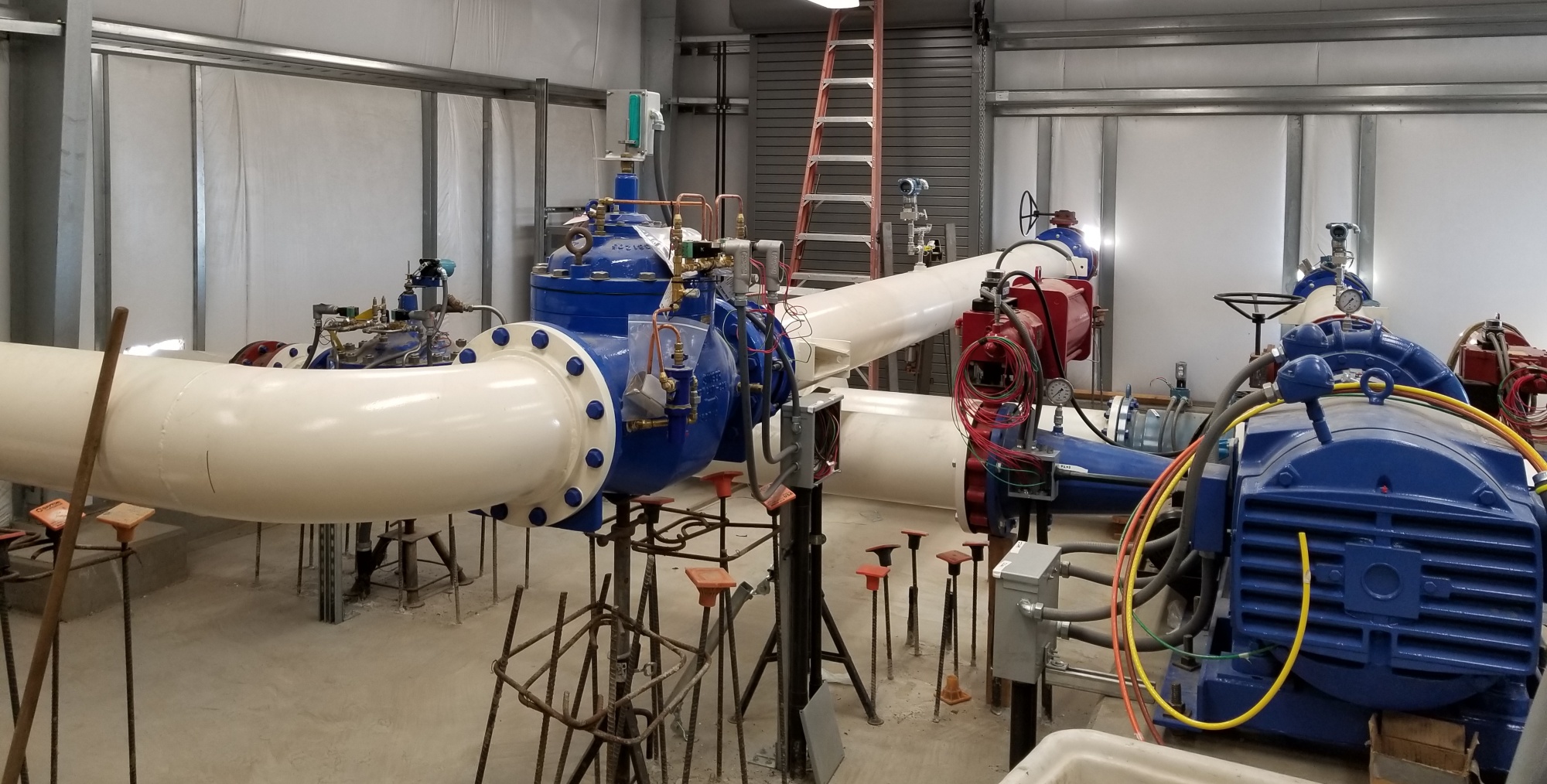
San Bernardino Valley Municipal Water District (SBVMWD) retained EETS to provide full electrical engineering design and construction phase services for a new two-unit pump-as-turbine (PaT) hydroelectric facility. The project objective was to reduce the District’s dependency on the electric grid, contribute 522kW of combined generation capacity, and reduce greenhouse gas emissions by substituting energy-recovering turbine units in place of an existing pressure reducing station.
As with any pipeline pressure reducing station, the existing facility was simply dissipating pressure energy as heat and turbulence rather than capturing it. The new hydroelectric facility taps into the high-pressure side of the pipeline, routes flow through two PaT generating units of different ratings that each operate according to upstream flow rates and pressures, and discharges into the low-pressure side. The result is a facility that recovers what was previously wasted energy and delivers it as generation interconnected with Southern California Edison under a utility interconnection agreement.
EETS scope included field investigation and document review, electrical design for the powerhouse building and all ancillary equipment, procurement specifications for turbine and generator units, protection and control panels, switchgear, and the PLC and SCADA panel, assistance with both equipment pre-purchase and general construction bid packages, construction phase services including site visits, submittal review, RFI responses, factory witness testing, instrument calibration review, and startup function testing, as well as development of protective relay settings and support for the Southern California Edison interconnection application. As-built drawing revisions were prepared upon project completion.
Project Challenge
Powerhouse Relocation Mid-Project
After the original construction bid documents had been released, the powerhouse building location was changed. The cause of the relocation was outside EETS’ scope and control, but the electrical design consequences fell squarely within it. Every conduit run, wire pull, and equipment connection that had been designed to the original building footprint now needed to be re-evaluated for the new location.
The relocation increased the distances between the powerhouse and its electrical connection points, requiring EETS to recalculate voltage drop across the affected circuits and resize conductors accordingly to maintain compliance with applicable standards. All affected drawings were revised to reflect the new routing and conductor sizing. The full electrical redesign was completed in less than two weeks, keeping the project on its startup schedule without requiring a schedule extension.
A Generator That Would Not Stay Online
After the original construction bid documents had been released, the powerhouse building location was changed. The cause of the relocation was outside EETS’ scope and control, but the electrical design consequences fell squarely within it. Every conduit run, wire pull, and equipment connection that had been designed to the original building footprint now needed to be re-evaluated for the new location.
The relocation increased the distances between the powerhouse and its electrical connection points, requiring EETS to recalculate voltage drop across the affected circuits and resize conductors accordingly to maintain compliance with applicable standards. All affected drawings were revised to reflect the new routing and conductor sizing. The full electrical redesign was completed in less than two weeks, keeping the project on its startup schedule without requiring a schedule extension.
Client
San Bernardino Valley Municipal Water District / West Valley Water District
Sector
Location
Southern California
Services
Electrical Engineering Design | Protection and Control | PLC Controls and SCADA | Utility Interconnection | Construction Services | Startup and Commissioning

Drink
As part of this expansion, AWA identified an opportunity to recover energy that was previously being wasted.
Client
San Bernardino Valley Municipal Water District / West Valley Water District
Sector
Location
Southern California
Services
Electrical Engineering Design | Protection and Control | PLC Controls and SCADA | Utility Interconnection | Construction Services | Startup and Commissioning
Drink
As part of this expansion, AWA identified an opportunity to recover energy that was previously being wasted.
Project Overview
San Bernardino Valley Municipal Water District (SBVMWD) retained EETS to provide full electrical engineering design and construction phase services for a new two-unit pump-as-turbine (PaT) hydroelectric facility. The project objective was to reduce the District’s dependency on the electric grid, contribute 522kW of combined generation capacity, and reduce greenhouse gas emissions by substituting energy-recovering turbine units in place of an existing pressure reducing station.
As with any pipeline pressure reducing station, the existing facility was simply dissipating pressure energy as heat and turbulence rather than capturing it. The new hydroelectric facility taps into the high-pressure side of the pipeline, routes flow through two PaT generating units of different ratings that each operate according to upstream flow rates and pressures, and discharges into the low-pressure side. The result is a facility that recovers what was previously wasted energy and delivers it as generation interconnected with Southern California Edison under a utility interconnection agreement.
EETS scope included field investigation and document review, electrical design for the powerhouse building and all ancillary equipment, procurement specifications for turbine and generator units, protection and control panels, switchgear, and the PLC and SCADA panel, assistance with both equipment pre-purchase and general construction bid packages, construction phase services including site visits, submittal review, RFI responses, factory witness testing, instrument calibration review, and startup function testing, as well as development of protective relay settings and support for the Southern California Edison interconnection application. As-built drawing revisions were prepared upon project completion.
Project Challenge
Powerhouse Relocation Mid-Project
After the original construction bid documents had been released, the powerhouse building location was changed. The cause of the relocation was outside EETS’ scope and control, but the electrical design consequences fell squarely within it. Every conduit run, wire pull, and equipment connection that had been designed to the original building footprint now needed to be re-evaluated for the new location.
The relocation increased the distances between the powerhouse and its electrical connection points, requiring EETS to recalculate voltage drop across the affected circuits and resize conductors accordingly to maintain compliance with applicable standards. All affected drawings were revised to reflect the new routing and conductor sizing. The full electrical redesign was completed in less than two weeks, keeping the project on its startup schedule without requiring a schedule extension.
A Generator That Would Not Stay Online
After the original construction bid documents had been released, the powerhouse building location was changed. The cause of the relocation was outside EETS’ scope and control, but the electrical design consequences fell squarely within it. Every conduit run, wire pull, and equipment connection that had been designed to the original building footprint now needed to be re-evaluated for the new location.
The relocation increased the distances between the powerhouse and its electrical connection points, requiring EETS to recalculate voltage drop across the affected circuits and resize conductors accordingly to maintain compliance with applicable standards. All affected drawings were revised to reflect the new routing and conductor sizing. The full electrical redesign was completed in less than two weeks, keeping the project on its startup schedule without requiring a schedule extension.
Key Technical Elements
Parameter | Detail |
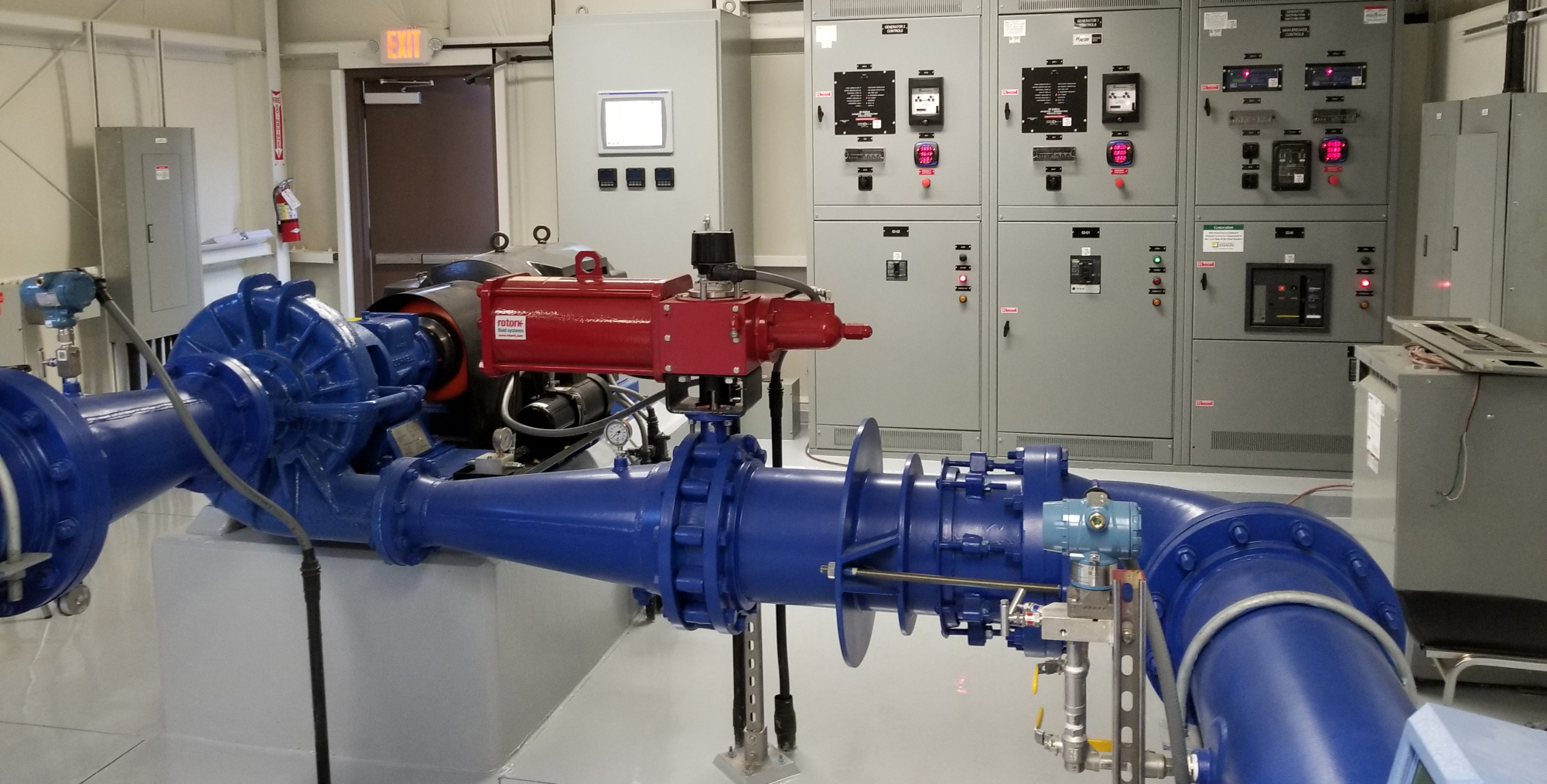
Generating Technology | Two pump-as-turbine (PaT) units with induction generators, each sized to operate at different ratings based on upstream flow and pressure conditions |
Combined Installed Capacity | 522 kW |
Generator Voltage | 480V three-phase |
Utility Interconnection | Southern California Edison |
Energy Recovery Concept | Pressure differential across existing pipeline PRS harvested in lieu of throttling and dissipating as heat |
Control System | PLC-based operating logic with SCADA communication |
Commissioning Challenge 1 | Powerhouse building relocated after bid documents released; full electrical redesign including voltage drop recalculation completed in under two weeks |
Commissioning Challenge 2 | Reverse power trip on startup traced to incorrectly wired potential transformer secondary at the factory; identified by EETS through systematic process of elimination |
Project Outcome
Both generating units are operating successfully and the facility is interconnected with Southern California Edison. SBVMWD / WVWD now recovers energy that was previously dissipated across the pressure reducing station, reducing its dependency on grid power and contributing to the District’s greenhouse gas reduction goals. The project was delivered on schedule despite the mid-project powerhouse relocation and the commissioning challenges encountered during startup.
Value Delivered by EETS
This project demonstrates EETS’s ability to maintain project momentum when conditions change and to resolve technically ambiguous commissioning failures under field pressure.
Absorbing Scope Changes Without Losing Schedule
When the powerhouse location changed after bid documents had already been released, the electrical design had to be substantially revised on short notice. EETS completed the full redesign, including revised conductor sizing, voltage drop calculations, and updated drawings, within two weeks. That response kept the project on its startup schedule and avoided what could have been a costly delay for the District.
Systematic Commissioning Diagnosis
The reverse power trip on startup was a problem that could have led to days or weeks of misdirected troubleshooting if approached without discipline. The generating equipment was functioning correctly. The protection settings were correct. The issue was in the wiring of a single potential transformer secondary, a factory error that was invisible until the system was energized and the relay began receiving incorrect voltage reference signals. EETS worked through the system methodically, eliminating each possible cause in turn, until the root cause was found and corrected. That kind of structured field diagnosis is what separates a days-long resolution from a weeks-long one.
Full Project Lifecycle Engagement
EETS was engaged from initial field investigation through final as-built drawings, covering design, procurement support, construction phase services, factory witness testing, and commissioning. That continuity meant that when problems arose during startup, the engineers responding in the field were the same engineers who had designed the system and reviewed the equipment submittals. Institutional knowledge of the design is one of the most valuable assets in a commissioning investigation, and it is not something that can be brought in from outside after the fact.
Drink
As part of this expansion, AWA identified an opportunity to recover energy that was previously being wasted.